DFS Topo Sort
Post-Order Is the Secret Weapon
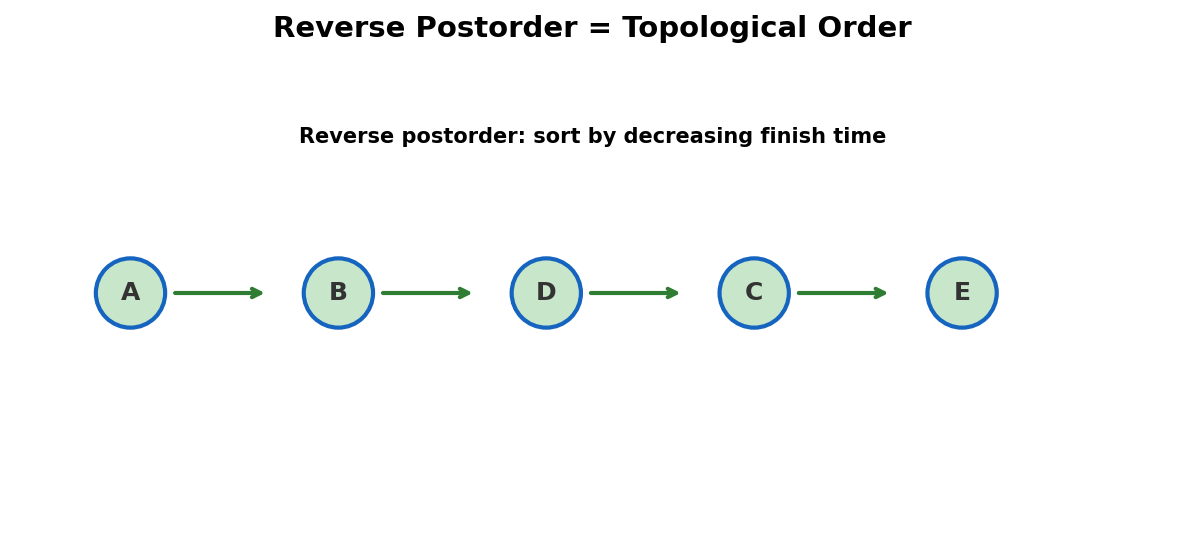
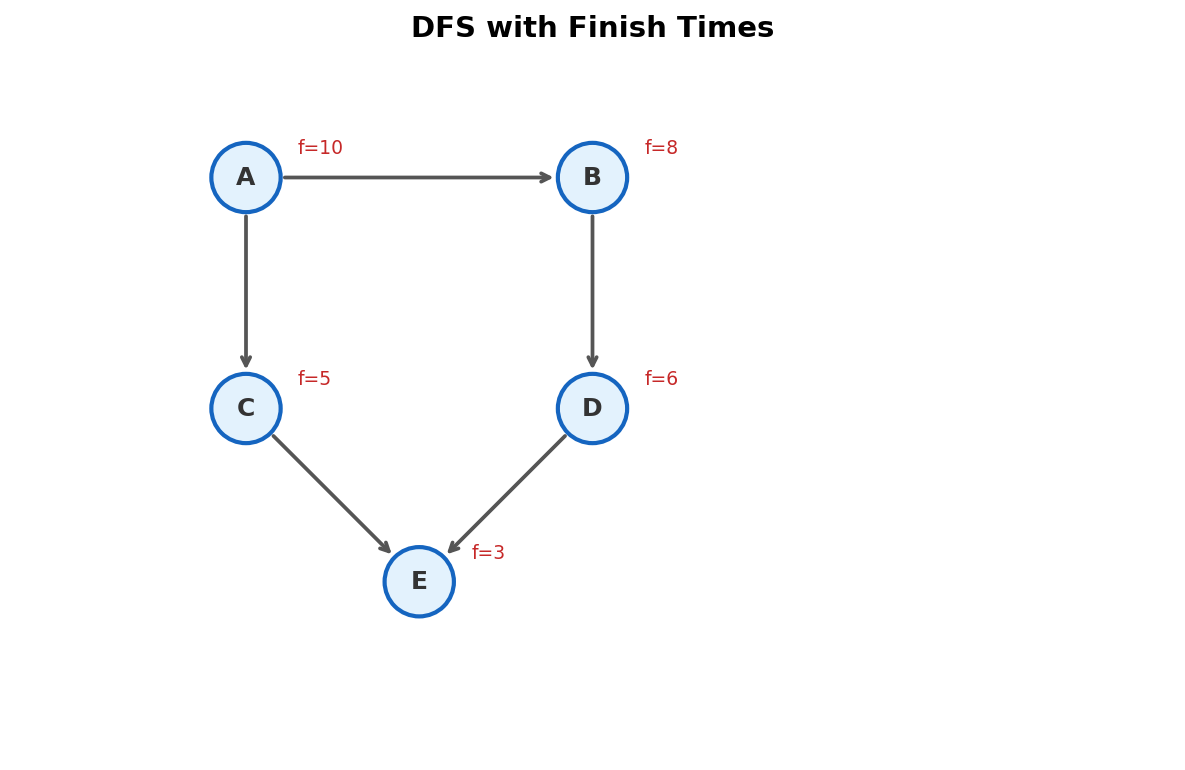
Here's a non-obvious claim: if you run DFS on a DAG and record each node when you finish it (not when you discover it), then reverse that list, you get a valid topological order. Every time.
Understanding why this works gives you a tool that extends far beyond topological sort -- into SCC detection, 2-SAT, and any problem that needs "process things in dependency order."
The Core Idea
When DFS finishes processing a node u, every node reachable from u has already been finished and added to the list. So u appears after all its descendants in the post-order list. Reversing puts u before all its descendants. That's exactly what topological order requires.
void dfs(int u) {
    color[u] = 1; // GRAY: in progress
    for (int v : adj[u]) {
        if (color[v] == 0) dfs(v);
        else if (color[v] == 1) has_cycle = true;
        if (has_cycle) return;
    }
    color[u] = 2; // BLACK: done
    order.push_back(u); // post-order
}
After calling dfs from every unvisited node, reverse order. That's your topological sort.
💡 Key insight. Post-order in DFS means "I finished after everything I depend on finished." Reversing turns that into "I appear before everything that depends on me."
Three-Color Cycle Detection
Undirected cycle detection uses a parent check. Directed cycle detection needs more -- it needs to distinguish between three states:
| Color | Meaning | What it tells you |
|---|---|---|
| WHITE (0) | Unvisited | Haven't touched this node yet |
| GRAY (1) | In current DFS path | Currently on the recursion stack |
| BLACK (2) | Fully processed | Done with this node and all descendants |
The rule: If you're at node u and encounter a GRAY neighbor v, then v is an ancestor of u on the current path. The path from v to u plus the edge u -> v forms a cycle.
Encountering a BLACK node is harmless. It means v was fully processed in an earlier DFS branch. There's no cycle through that edge.
⚠ Gotcha. In directed graphs, you CANNOT use the simple "visited and not parent" check from undirected cycle detection. A visited node might be BLACK (fully processed from another branch), not part of your current path. Only GRAY nodes indicate cycles.
Full Trace with Colors
Consider this 6-node DAG:
Adjacency list: 1:[2,3], 2:[4], 3:[4,5], 4:[], 5:[6], 6:[]
| Step | Call | Action | Colors (1-6) | Post-Order |
|---|---|---|---|---|
| 1 | dfs(1) | Mark 1 GRAY, visit 2 | G W W W W W | [] |
| 2 | dfs(2) | Mark 2 GRAY, visit 4 | G G W W W W | [] |
| 3 | dfs(4) | Mark 4 GRAY, no neighbors | G G W G W W | [] |
| 4 | dfs(4) | Mark 4 BLACK, push 4 | G G W B W W | [4] |
| 5 | dfs(2) | Mark 2 BLACK, push 2 | G B W B W W | [4, 2] |
| 6 | dfs(1) | Visit 3 | G B W B W W | [4, 2] |
| 7 | dfs(3) | Mark 3 GRAY, visit 4 (BLACK, skip) | G B G B W W | [4, 2] |
| 8 | dfs(3) | Visit 5 | G B G B W W | [4, 2] |
| 9 | dfs(5) | Mark 5 GRAY, visit 6 | G B G B G W | [4, 2] |
| 10 | dfs(6) | Mark 6 GRAY→BLACK, push 6 | G B G B G B | [4, 2, 6] |
| 11 | dfs(5) | Mark 5 BLACK, push 5 | G B G B B B | [4, 2, 6, 5] |
| 12 | dfs(3) | Mark 3 BLACK, push 3 | G B B B B B | [4, 2, 6, 5, 3] |
| 13 | dfs(1) | Mark 1 BLACK, push 1 | B B B B B B | [4, 2, 6, 5, 3, 1] |
Post-order: [4, 2, 6, 5, 3, 1]
Reversed: 1, 3, 5, 6, 2, 4
Check: every edge goes left-to-right in this order. Valid topological sort.
Notice step 7: node 3 sees node 4, which is BLACK. This is fine -- it's not on the current path. No cycle.
Cycle Detection Trace
Now add edge 4 → 1 to create a cycle.
| Step | Call | Action | Colors (1-4) | Result |
|---|---|---|---|---|
| 1 | dfs(1) | Mark 1 GRAY, visit 2 | G W W W | -- |
| 2 | dfs(2) | Mark 2 GRAY, visit 4 | G G W W | -- |
| 3 | dfs(4) | Mark 4 GRAY, visit 1 | G G W G | -- |
| 4 | dfs(4) | Node 1 is GRAY! | G G W G | CYCLE |
Node 4 sees node 1, which is GRAY. That means 1 is on the current path: 1 → 2 → 4 → 1. Cycle found.
CSES Round Trip II -- Extracting the Cycle
The problem asks: given a directed graph, find a cycle and print it, or report that none exists.
Detection is step one. Extraction requires tracking parents:
int par[200005];
int cycleStart = -1, cycleEnd = -1;

void dfs(int u) {
    color[u] = 1;
    for (int v : adj[u]) {
        if (color[v] == 1) {
            cycleStart = v;
            cycleEnd = u;
            return;
        }
        if (color[v] == 0) {
            par[v] = u;
            dfs(v);
        }
        if (cycleStart != -1) return;
    }
    color[u] = 2;
}
When you find cycleStart and cycleEnd, walk back through par[]:
vector<int> cycle;
cycle.push_back(cycleStart);
for (int v = cycleEnd; v != cycleStart; v = par[v])
    cycle.push_back(v);
cycle.push_back(cycleStart);
reverse(cycle.begin(), cycle.end());
For our cycle 1 → 2 → 4 → 1 (cycleStart = 1, cycleEnd = 4):
| Walk | Current | par[current] | Path |
|---|---|---|---|
| Start | -- | -- | [1] |
| 1 | 4 | 2 | [1, 4] |
| 2 | 2 | 1 | [1, 4, 2] |
| Stop | 1 == cycleStart | -- | [1, 4, 2, 1] |
Reversed: 1 → 2 → 4 → 1.
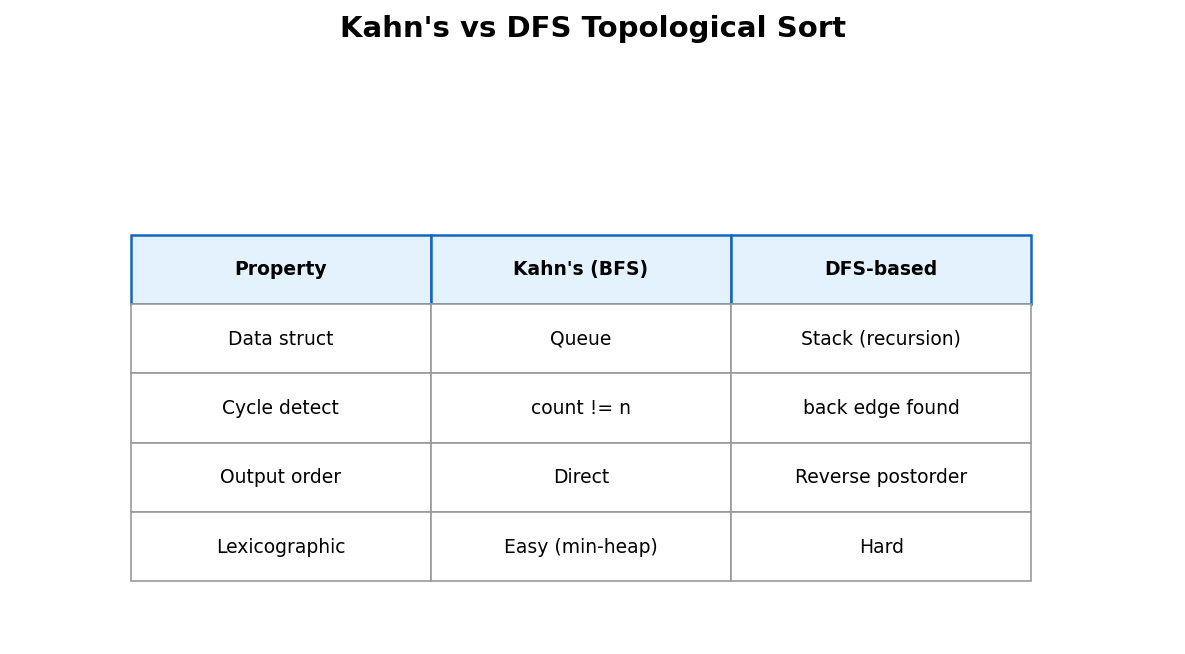
Kahn's vs DFS Topo Sort
| Aspect | Kahn's (BFS) | DFS |
|---|---|---|
| Style | Iterative | Recursive |
| Cycle detection | order.size() < n |
GRAY node encountered |
| Cycle extraction | Harder (nodes with remaining in-degree) | Natural (parent chain) |
| Stack overflow | No risk | Risk on deep graphs |
| Complexity | O(V + E) | O(V + E) |
Both are O(V + E). Both produce valid topological orderings. In practice:
- Use Kahn's when you just need any valid ordering and want simple, iterative code.
- Use DFS when you need to extract cycles or when the problem naturally involves DFS (SCC, etc.).
💡 Key insight. Kahn's peels nodes from the "outside in" (no-dependency nodes first). DFS drills from the "inside out" (deepest dependencies first, then reverses). Same result, opposite direction.
LC 802 -- Find Eventual Safe States
A node is "safe" if every path starting from it leads to a terminal node (a node with out-degree 0). Equivalently, a node is safe if it's NOT part of a cycle and NOT reachable to a cycle.
Run three-color DFS. After DFS completes: - BLACK nodes are safe. - GRAY nodes (stuck in cycles) are unsafe.
vector<int> eventualSafeNodes(vector<vector<int>>& graph) {
    int n = graph.size();
    vector<int> color(n, 0);
    vector<int> result;

    function<bool(int)> dfs = [&](int u) -> bool {
        color[u] = 1;
        for (int v : graph[u]) {
            if (color[v] == 1) return false;
            if (color[v] == 0 && !dfs(v)) return false;
        }
        color[u] = 2;
        return true;
    };

    for (int i = 0; i < n; i++) {
        if (color[i] == 0) dfs(i);
        if (color[i] == 2) result.push_back(i);
    }
    return result;
}
Try It
The starter code has the DFS skeleton. Fill in the cycle detection and post-order push.
Test case 1 -- DAG:
Test case 2 -- cycle:
Challenge: Modify the code to print the actual cycle when one is detected, not just "IMPOSSIBLE."
Problems
| Problem | Link | Difficulty |
|---|---|---|
| CSES Round Trip II | cses.fi/problemset/task/1678 | Medium |
| LC 207 — Course Schedule | leetcode.com/problems/course-schedule | Medium |
| LC 802 — Find Eventual Safe States | leetcode.com/problems/find-eventual-safe-states | Medium |