Weighted DSU
When "Same Set" Isn't Enough
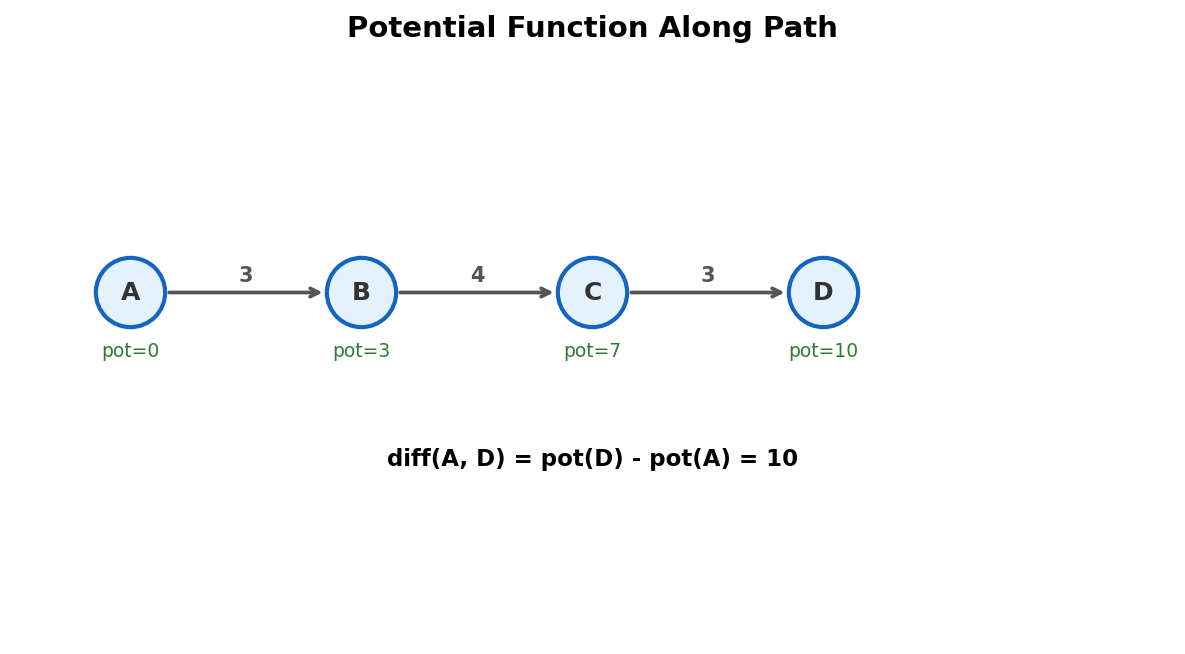
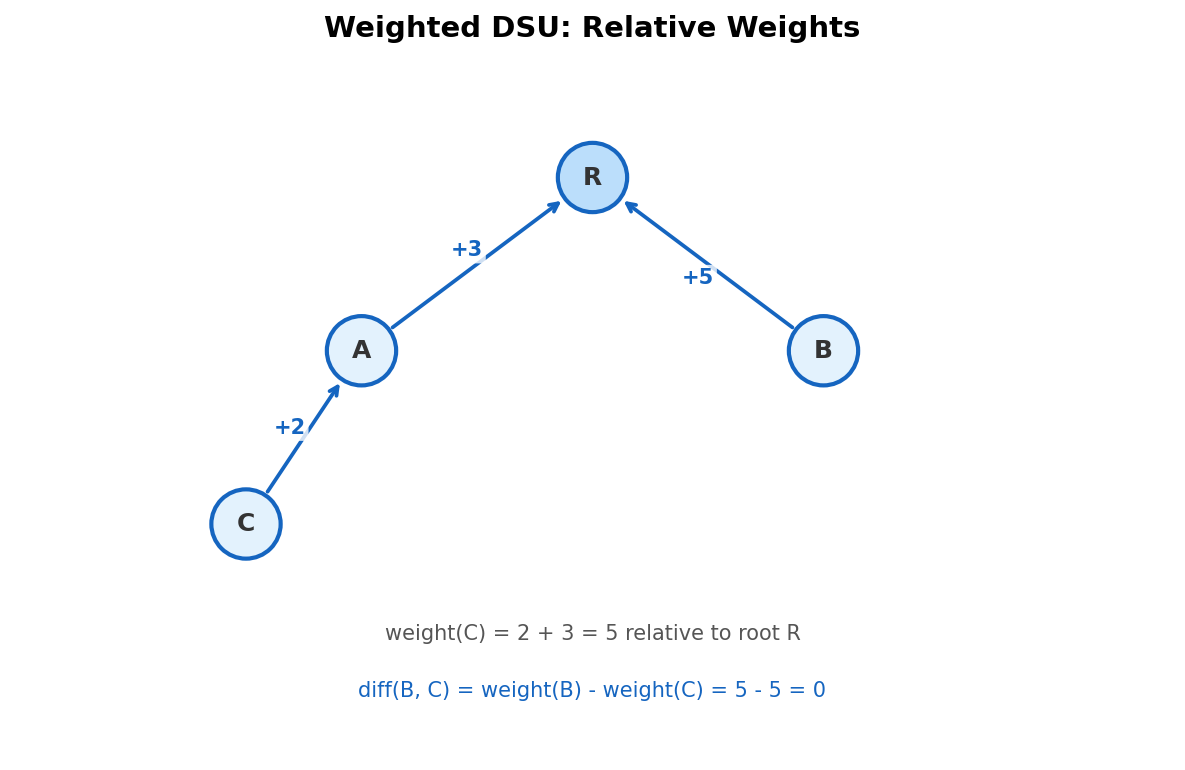
Standard DSU answers one question: are A and B connected? But many problems need more. "What is the ratio of A to B?" "Are A and B in the same group or opposite groups?" "What is A's distance from B?" Plain connectivity can't answer these. You need a DSU that carries data along every edge.
Weighted DSU attaches a value to each parent link. When you find the root, you accumulate these values along the path. The result tells you the relationship between any node and its root -- and by extension, between any two nodes in the same component.
The Weight Array
In standard DSU, par[x] points to the parent. In weighted DSU, wt[x] stores the relationship between x and par[x].
The interpretation depends on the problem:
| Problem type | wt[x] means | Operation |
|---|---|---|
| Ratios (LC 399) | val(x) / val(par[x]) | Multiply along path |
| Distances | dist(x) - dist(par[x]) | Add along path |
| Parity | x and par[x] in same/different group | XOR along path |
Find with Weight Compression
Path compression in standard DSU just reassigns parent pointers. In weighted DSU, you must also update the weight to reflect the direct relationship to the new root.
int par[200005], rnk[200005];
double wt[200005]; // wt[x] = val(x) / val(par[x])

int find(int x) {
    if (par[x] == x) return x;
    int root = find(par[x]);
    wt[x] *= wt[par[x]]; // accumulate ratio to root
    par[x] = root;
    return root;
}
Before compression: x -> A -> B -> root, with wt[x] = val(x)/val(A), wt[A] = val(A)/val(B), wt[B] = val(B)/val(root).
After compression: x -> root, with wt[x] = val(x)/val(root) = wt[x] * wt[A] * wt[B].
💡 Key insight. The find function does two things at once: finds the root AND computes the cumulative weight. After find(x), wt[x] gives you the direct relationship between x and its root.
Unite with Weights
When uniting a and b with a known relationship w = val(a)/val(b), we need to compute the correct weight for the edge between their roots.
bool unite(int a, int b, double w) {
    int ra = find(a), rb = find(b);
    if (ra == rb) {
        // Already connected — check consistency
        return abs(wt[a] / wt[b] - w) < 1e-9;
    }
    // After find: wt[a] = val(a)/val(ra), wt[b] = val(b)/val(rb)
    // We want: val(ra)/val(rb) = ?
    // val(a)/val(b) = w
    // val(a) = wt[a] * val(ra), val(b) = wt[b] * val(rb)
    // So: wt[a]*val(ra) / (wt[b]*val(rb)) = w
    // val(ra)/val(rb) = w * wt[b] / wt[a]
    if (rnk[ra] < rnk[rb]) {
        par[ra] = rb;
        wt[ra] = w * wt[b] / wt[a];
    } else {
        par[rb] = ra;
        wt[rb] = wt[a] / (w * wt[b]);
        if (rnk[ra] == rnk[rb]) rnk[ra]++;
    }
    return true;
}
⚠ Gotcha. Call
find(a)andfind(b)before computing the root weight. The find calls updatewt[a]andwt[b]to be relative to their respective roots. If you skip this, the algebra breaks.
Querying the Relationship
To get val(a)/val(b) for two nodes in the same component:
double query(int a, int b) {
    if (find(a) != find(b)) return -1.0; // undefined
    return wt[a] / wt[b];
}
After find(a), wt[a] = val(a)/val(root). After find(b), wt[b] = val(b)/val(root). So wt[a]/wt[b] = val(a)/val(b). Clean.
Full Trace: Ratio Queries
Variables: a, b, c, d. Process: a/b = 2.0, b/c = 3.0, query a/c, query a/d.
| Operation | Action | par[] | wt[] | Notes |
|---|---|---|---|---|
| init | -- | [a,b,c,d] | [1,1,1,1] | Each node is its own root |
| a/b = 2.0 | unite(a,b,2.0) | [a,a,c,d] | [1,0.5,1,1] | par[b]=a, wt[b]=wt[a]/(2.0*wt[b])=0.5 |
| b/c = 3.0 | unite(b,c,3.0): find(b)->wt[b]=0.5, find(c)->wt[c]=1 | [a,a,a,d] | [1,0.5,0.167,1] | par[c]=a, wt[c]=wt[b]/(3.0*wt[c])=0.167 |
| query a/c | find(a)->wt[a]=1, find(c)->wt[c]=0.167 | -- | -- | wt[a]/wt[c] = 1/0.167 = 6.0 |
| query a/d | find(a) != find(d) | -- | -- | Return -1.0 (not connected) |
Result: a/c = 6.0 (correct: a/b * b/c = 2 * 3 = 6). a/d = -1.0 (unknown).
Parity DSU: The XOR Variant
Some problems ask: "Are A and B in the same group or opposite groups?" This is a parity relationship. Instead of multiplying weights, XOR them.
int par[200005], rnk[200005], rel[200005];
// rel[x]: 0 = same group as par[x], 1 = different group

int find(int x) {
    if (par[x] == x) return x;
    int root = find(par[x]);
    rel[x] ^= rel[par[x]];
    par[x] = root;
    return root;
}

// unite a and b, where r = 0 means same group, 1 means different
bool unite(int a, int b, int r) {
    int ra = find(a), rb = find(b);
    if (ra == rb) {
        return (rel[a] ^ rel[b]) == r; // consistency check
    }
    if (rnk[ra] < rnk[rb]) swap(ra, rb), swap(a, b);
    par[rb] = ra;
    rel[rb] = rel[a] ^ rel[b] ^ r;
    if (rnk[ra] == rnk[rb]) rnk[ra]++;
    return true;
}
After find(a) and find(b), rel[a] ^ rel[b] tells you whether a and b are in the same group (0) or different groups (1).
💡 Key insight. Parity DSU is just weighted DSU where the "weight" is a single bit and the "accumulation" is XOR. The structure is identical.
LC 399: Evaluate Division
Problem: Given equations like a/b = 2.0 and b/c = 3.0, answer queries like "what is a/c?"
This is a direct application of weighted DSU with multiplicative weights.
class Solution {
public:
    vector<double> calcEquation(
        vector<vector<string>>& equations,
        vector<double>& values,
        vector<vector<string>>& queries
    ) {
        unordered_map<string, int> id;
        int cnt = 0;
        for (auto& eq : equations)
            for (auto& s : eq)
                if (!id.count(s)) id[s] = cnt++;

        vector<int> par(cnt), rnk(cnt, 0);
        vector<double> wt(cnt, 1.0);
        iota(par.begin(), par.end(), 0);

        function<int(int)> find = [&](int x) -> int {
            if (par[x] == x) return x;
            int root = find(par[x]);
            wt[x] *= wt[par[x]];
            par[x] = root;
            return root;
        };

        auto unite = [&](int a, int b, double w) {
            int ra = find(a), rb = find(b);
            if (ra == rb) return;
            if (rnk[ra] < rnk[rb]) swap(ra, rb), swap(a, b), w = 1.0 / w;
            par[rb] = ra;
            wt[rb] = wt[a] / (w * wt[b]);
            if (rnk[ra] == rnk[rb]) rnk[ra]++;
        };

        for (int i = 0; i < (int)equations.size(); i++)
            unite(id[equations[i][0]], id[equations[i][1]], values[i]);

        vector<double> ans;
        for (auto& q : queries) {
            if (!id.count(q[0]) || !id.count(q[1])) {
                ans.push_back(-1.0);
            } else {
                int a = id[q[0]], b = id[q[1]];
                if (find(a) != find(b)) {
                    ans.push_back(-1.0);
                } else {
                    ans.push_back(wt[a] / wt[b]);
                }
            }
        }
        return ans;
    }
};
AtCoder arc111_b: Reversible Cards
Problem: N cards, each with a front value and back value. You can flip any card. Maximize the number of distinct values visible.
DSU insight: Each card creates an edge between its front and back values. Within each connected component of k nodes and e edges, you can choose at most min(k, e) distinct values to show. If the component has a cycle (e >= k), you can show all k values. If it's a tree (e = k-1), you can show k-1.
This uses standard DSU augmented with cycle detection: if find(a) == find(b) when processing an edge, that component has a cycle.
Try It
The starter code provides the weighted DSU skeleton. Implement find with weight compression and unite with weight algebra.
Test case 1:
Test case 2:
Test case 3:
Challenge: Implement a parity DSU and solve the following: given pairs (a,b) labeled "same" or "different", determine if a contradiction exists.
Problems
| Problem | Link | Difficulty |
|---|---|---|
| LC 399 — Evaluate Division | leetcode.com/problems/evaluate-division | Medium |
| LC 990 — Satisfiability of Equality Equations | leetcode.com/problems/satisfiability-of-equality-equations | Medium |
| AtCoder arc111_b — Reversible Cards | atcoder.jp/contests/arc111/tasks/arc111_b | Medium |