Condensation Graph
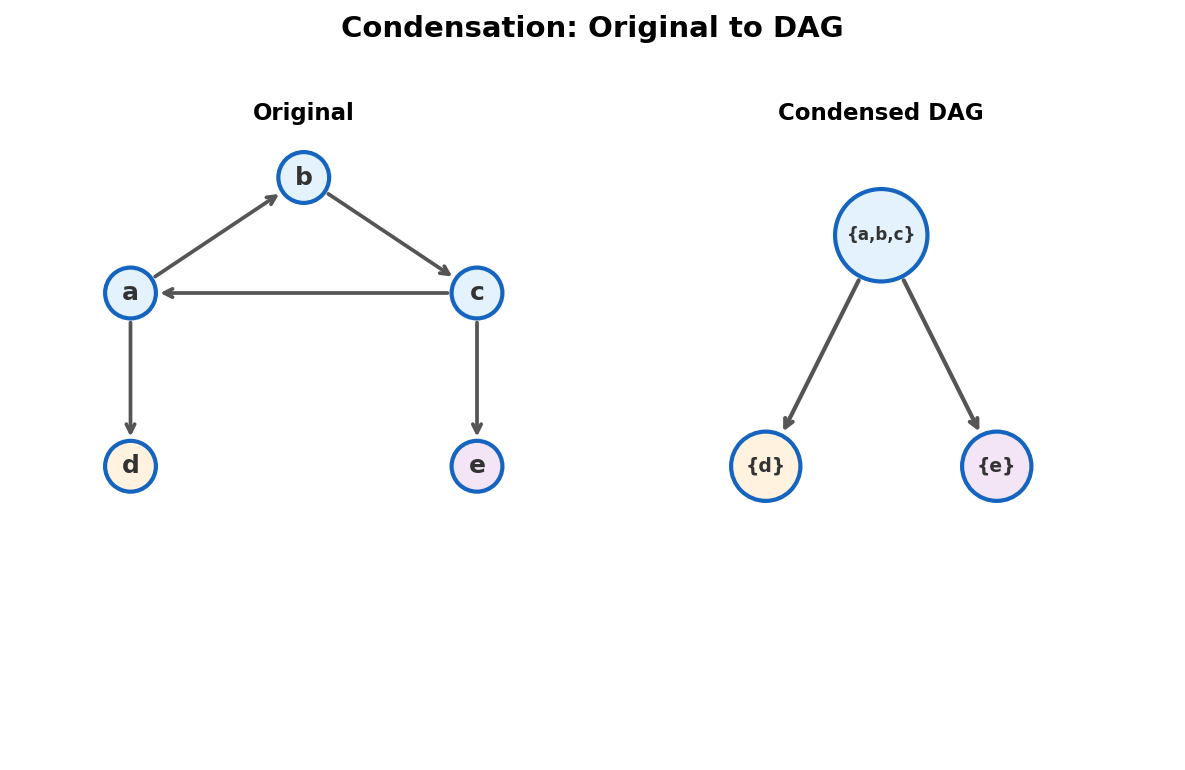
Collapse Cycles, Unlock DP
Directed graphs with cycles can't be topologically sorted. DP on them seems impossible. But here's the trick: every SCC is a cycle (or a single node). Contract each SCC into a single super-node. The result is a DAG -- the condensation graph. Now you can topo-sort it and run DP. This pattern unlocks a whole class of problems.
What Is the Condensation Graph?
Given a directed graph G:
- Find all SCCs. Assign each node to its SCC.
- Create a new graph where each SCC is a single node.
- For each edge (u, v) in G where comp[u] != comp[v], add edge (comp[u], comp[v]) to the condensation.
- Remove duplicate edges.
The result is guaranteed to be a DAG. Why? If two super-nodes had a cycle between them, the nodes in both SCCs could reach each other, making them one big SCC. That contradicts the maximality of SCCs.
Building the Condensation
// After Kosaraju's: comp[u] = SCC id for each node
// numSCC = total number of SCCs

vector<vector<int>> dag(numSCC);
vector<int> indeg(numSCC, 0);
set<pair<int,int>> seen;

for (int u = 1; u <= n; u++) {
    for (int v : adj[u]) {
        if (comp[u] != comp[v]) {
            if (seen.insert({comp[u], comp[v]}).second) {
                dag[comp[u]].push_back(comp[v]);
                indeg[comp[v]]++;
            }
        }
    }
}
⚠ Gotcha. Without deduplication, the condensation can have O(E) edges even though only O(V) are unique. The
set<pair<int,int>>prevents duplicates. For tighter memory, sort and deduplicate instead.
CSES Coin Collector
Problem: N rooms, M one-way corridors. Each room has some coins. You start in any room, collect coins, and follow corridors. You can visit a room multiple times but only collect its coins once. Maximize total coins collected.
Key observation: If two rooms are in the same SCC, you can visit both. So you always collect all coins in every SCC you enter. The problem reduces to: find the path in the condensation DAG that maximizes the sum of SCC coin totals.
Steps:
- Find SCCs with Kosaraju's.
- Sum coins per SCC.
- Build condensation DAG.
- DP longest path on the DAG.
#include <bits/stdc++.h>
using namespace std;

const int MAXN = 200005;
vector<int> adj[MAXN], radj[MAXN];
int comp[MAXN];
bool vis[MAXN];
vector<int> order;
long long coins[MAXN];

void dfs1(int u) {
    vis[u] = true;
    for (int v : adj[u])
        if (!vis[v]) dfs1(v);
    order.push_back(u);
}

void dfs2(int u, int c) {
    comp[u] = c;
    for (int v : radj[u])
        if (comp[v] == -1) dfs2(v, c);
}

int main() {
    int n, m;
    cin >> n >> m;
    for (int i = 1; i <= n; i++) cin >> coins[i];
    for (int i = 0; i < m; i++) {
        int u, v;
        cin >> u >> v;
        adj[u].push_back(v);
        radj[v].push_back(u);
    }

    for (int i = 1; i <= n; i++)
        if (!vis[i]) dfs1(i);

    memset(comp, -1, sizeof(comp));
    int numSCC = 0;
    for (int i = (int)order.size() - 1; i >= 0; i--)
        if (comp[order[i]] == -1)
            dfs2(order[i], numSCC++);

    // Sum coins per SCC
    vector<long long> sccCoins(numSCC, 0);
    for (int i = 1; i <= n; i++)
        sccCoins[comp[i]] += coins[i];

    // Build condensation DAG
    vector<vector<int>> dag(numSCC);
    set<pair<int,int>> seen;
    for (int u = 1; u <= n; u++)
        for (int v : adj[u])
            if (comp[u] != comp[v])
                if (seen.insert({comp[u], comp[v]}).second)
                    dag[comp[u]].push_back(comp[v]);

    // DP: longest path on DAG
    // Kosaraju's comp 0 is a source SCC.
    // Process in order 0, 1, ..., numSCC-1
    // (this is topological order of condensation).
    vector<long long> dp(numSCC);
    for (int c = 0; c < numSCC; c++)
        dp[c] = sccCoins[c];

    for (int c = 0; c < numSCC; c++)
        for (int nc : dag[c])
            dp[nc] = max(dp[nc], dp[c] + sccCoins[nc]);

    cout << *max_element(dp.begin(), dp.end()) << "\n";
}
Trace on small example:
Graph: 1->2, 2->3, 3->1, 3->4, 4->5, 5->4. Coins: [5, 3, 2, 7, 1].
| Step | Result |
|---|---|
| SCCs | {1,2,3} (comp=0), {4,5} (comp=1) |
| SCC coins | [10, 8] |
| DAG edges | 0 -> 1 |
| DP | dp[0] = 10, dp[1] = max(8, 10+8) = 18 |
| Answer | 18 |
💡 Key insight. The DP processes SCCs in topological order. Kosaraju's naturally gives SCCs numbered in topological order of the condensation (comp 0 is a source, comp numSCC-1 is a sink). No separate topo sort needed.
CSES Flight Routes Check
Problem: N cities, M flights (directed). Check if you can fly from any city to any other city. If not, print a pair of cities with no route between them.
Translation: The graph is strongly connected if and only if there is exactly 1 SCC.
#include <bits/stdc++.h>
using namespace std;

const int MAXN = 200005;
vector<int> adj[MAXN], radj[MAXN];
int comp[MAXN];
bool vis[MAXN];
vector<int> order;
vector<int> members[MAXN];

void dfs1(int u) {
    vis[u] = true;
    for (int v : adj[u])
        if (!vis[v]) dfs1(v);
    order.push_back(u);
}

void dfs2(int u, int c) {
    comp[u] = c;
    members[c].push_back(u);
    for (int v : radj[u])
        if (comp[v] == -1) dfs2(v, c);
}

int main() {
    int n, m;
    cin >> n >> m;
    for (int i = 0; i < m; i++) {
        int u, v;
        cin >> u >> v;
        adj[u].push_back(v);
        radj[v].push_back(u);
    }

    for (int i = 1; i <= n; i++)
        if (!vis[i]) dfs1(i);

    memset(comp, -1, sizeof(comp));
    int numSCC = 0;
    for (int i = (int)order.size() - 1; i >= 0; i--)
        if (comp[order[i]] == -1)
            dfs2(order[i], numSCC++);

    if (numSCC == 1) {
        cout << "YES\n";
    } else {
        cout << "NO\n";
        // Find two nodes in different SCCs.
        // Source SCC (comp 0) can reach others but
        // others can't reach it. Pick a node in comp 0
        // and a node in another SCC.
        // Node in comp 0 can't be reached from comp 1.
        cout << members[1][0] << " " << members[0][0] << "\n";
    }
}
⚠ Gotcha. The problem asks for a pair (a, b) where there's no route from a to b. A node in a non-source SCC can't reach the source SCC, so print (non-source node, source node). Getting the direction wrong gives wrong answer.
The Condensation Pattern
Almost every SCC problem follows this template:
- Find SCCs (Kosaraju's or Tarjan's).
- Aggregate per-SCC values (sum coins, count nodes, etc.).
- Build condensation DAG (deduplicate edges).
- DP on the DAG (longest path, reachability, counting).
The DP is always straightforward because the condensation is a DAG. The hard part is recognizing that the problem has SCC structure.
| Problem Variant | What to Aggregate | DP Type |
|---|---|---|
| Max coins | Sum of coin values | Longest path |
| Can all nodes communicate? | SCC count | Check count == 1 |
| Min cost to connect all | SCC in/out degrees | Count sources/sinks |
| Which nodes reach a cycle? | SCC sizes | Reachability (next lesson) |
Try It
The starter code has Kosaraju's ready. Add condensation construction and DP.
Test case (Coin Collector):
Test case (Flight Routes Check):
Problems
| Problem | Link | Difficulty |
|---|---|---|
| CSES Coin Collector | cses.fi/problemset/task/1686 | Medium |
| CSES Flight Routes Check | cses.fi/problemset/task/1682 | Easy |