Maximum Sum BST
When Postorder Carries More Than One Value
You saw pair-return in Chapter 3 — returning two values from a recursive call so the parent can make a decision without re-traversing children. This problem pushes that idea further. You need to return four pieces of information from each subtree, and the parent combines all of them in a single step.
Problem: Maximum Sum BST (LC 1373)
Problem: Given a binary tree, find the maximum sum of all keys of any subtree which is also a Binary Search Tree (BST). If no BST subtree exists, return 0.
A subtree must include all of its descendants. A single node is a valid BST.
The subtree rooted at node 3 is not a BST (left child 2, right child 5, but 3 is a BST root — wait, is it?). The subtree rooted at node 5 with children 4 and 6 IS a valid BST with sum \(5 + 4 + 6 = 15\). The answer is 20 (the subtree rooted at 3: \(3 + 2 + 5 + 4 + 6 = 20\), which is a valid BST).
What Each Node Needs to Know
To decide whether a subtree rooted at node \(X\) is a valid BST, you need:
- Is the left subtree a BST? If not, \(X\)'s subtree can't be either.
- Is the right subtree a BST? Same reason.
- The maximum value in the left subtree. It must be less than \(X.val\) for BST property.
- The minimum value in the right subtree. It must be greater than \(X.val\).
- The sum of the left subtree and sum of the right subtree — so you can compute this subtree's total sum.
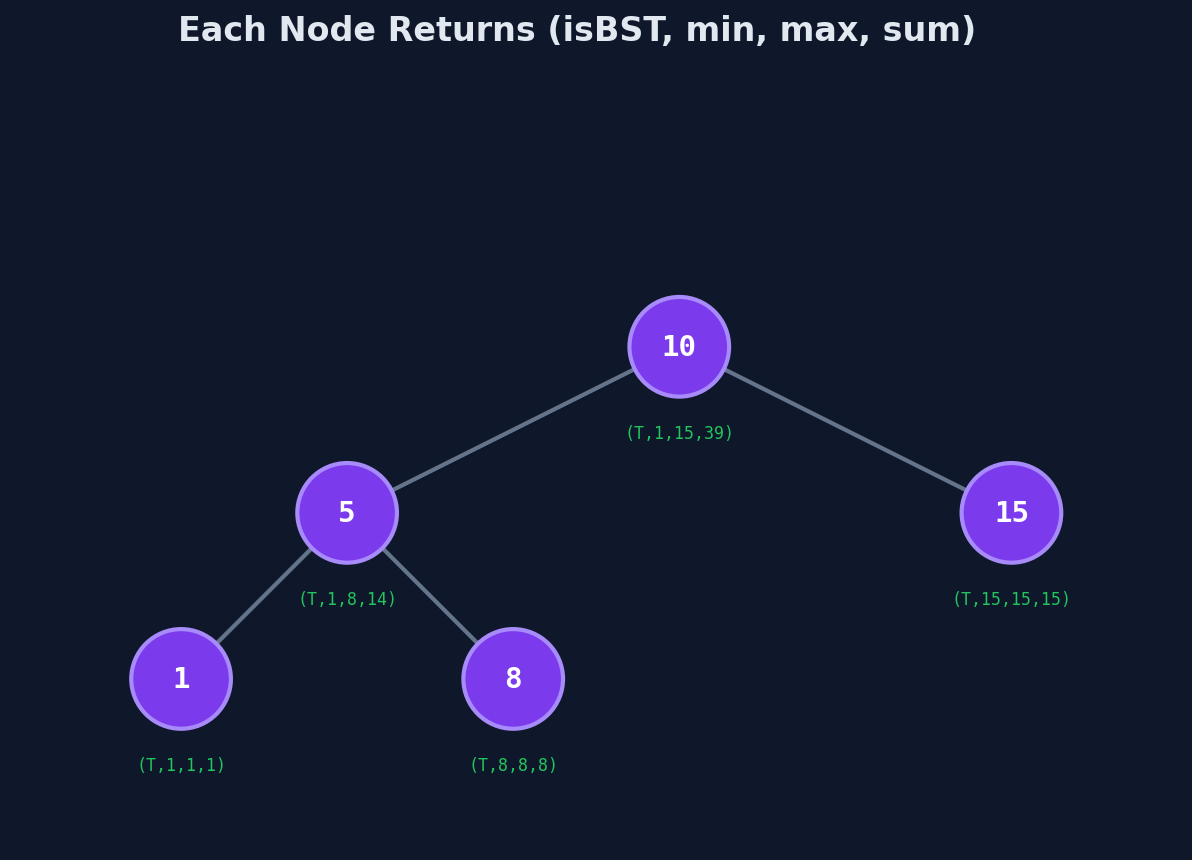
That's a lot of information. But it all flows upward in one pass. Each node returns a tuple: \(\{isBST, minVal, maxVal, subtreeSum\}\).
The pattern: Postorder with a multi-value return. Each node makes a local decision using only what its children reported. No re-traversal, no global state except the running maximum.
The Null Node Convention
What should a null node return? It should not break any BST check. A null left child should report a maximum value of \(-\infty\) (so that \(-\infty < node.val\) is always true). A null right child should report a minimum value of \(+\infty\) (so that \(+\infty > node.val\) is always true). Both are valid BSTs with sum 0.
So: \(\text{null} \to \{isBST: true, minVal: +\infty, maxVal: -\infty, sum: 0\}\).
This is the same trick as returning \(-1\) for height of null — pick the identity value that makes the parent's logic work without special cases.
Full Trace
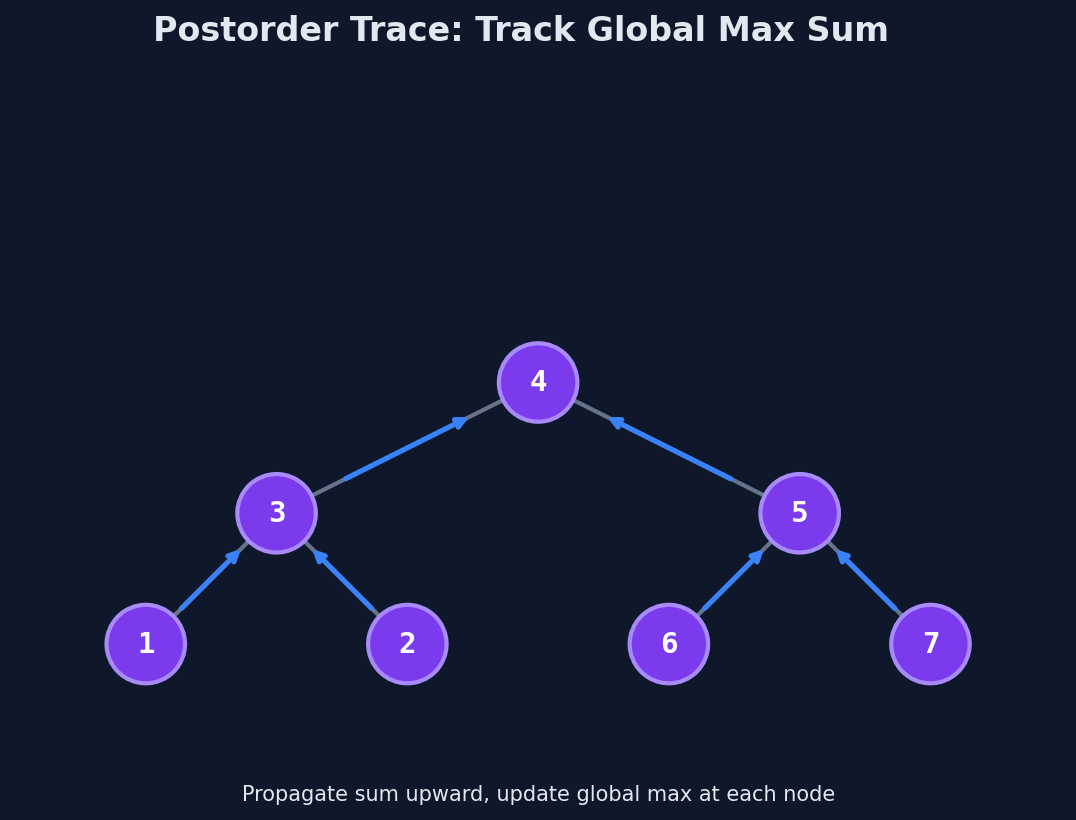
We process postorder (leaves first, root last). For brevity, using \(+\infty = 2 \times 10^9\) and \(-\infty = -2 \times 10^9\).
| Node | Left Info | Right Info | BST check | isBST | min | max | sum | globalMax |
|---|---|---|---|---|---|---|---|---|
| 2 (left of 4) | null: {T, \(+\infty\), \(-\infty\), 0} | null: {T, \(+\infty\), \(-\infty\), 0} | T and T and \(-\infty < 2\) and \(+\infty > 2\) | T | 2 | 2 | 2 | 2 |
| 4 (right of 4) | null | null | same as above | T | 4 | 4 | 4 | 4 |
| 4 (left of root) | {T, 2, 2, 2} | {T, 4, 4, 4} | T and T and \(2 < 4\) and \(4 > 4\)? No (\(4 \not> 4\)) | F | 2 | 4 | 10 | 4 |
| 2 (left of 3) | null | null | valid | T | 2 | 2 | 2 | 4 |
| 4 (left of 5) | null | null | valid | T | 4 | 4 | 4 | 4 |
| 6 (right of 5) | null | null | valid | T | 6 | 6 | 6 | 6 |
| 5 | {T, 4, 4, 4} | {T, 6, 6, 6} | T and T and \(4 < 5\) and \(6 > 5\) | T | 4 | 6 | 15 | 15 |
| 3 | {T, 2, 2, 2} | {T, 4, 6, 15} | T and T and \(2 < 3\) and \(4 > 3\) | T | 2 | 6 | 20 | 20 |
| 1 (root) | {F, 2, 4, 10} | {T, 2, 6, 20} | F (left is not BST) | F | 1 | 6 | 31 | 20 |
Final answer: \(globalMax = 20\).
Manual verification: The subtree rooted at 3 has nodes \(\{2, 3, 4, 5, 6\}\). In-order: \(2, 3, 4, 5, 6\) — sorted, so it's a valid BST. Sum \(= 2 + 3 + 4 + 5 + 6 = 20\). Correct.
The Code
struct SubtreeInfo {
    bool isBST;
    int minVal;
    int maxVal;
    int subtreeSum;
};

SubtreeInfo solve(TreeNode* node, int& globalMaxSum) {
    if (!node) return {true, (int)2e9, (int)-2e9, 0};

    auto leftInfo = solve(node->left, globalMaxSum);
    auto rightInfo = solve(node->right, globalMaxSum);

    bool validBST = leftInfo.isBST && rightInfo.isBST
                    && leftInfo.maxVal < node->val
                    && rightInfo.minVal > node->val;

    int currentSum = leftInfo.subtreeSum + rightInfo.subtreeSum + node->val;

    if (validBST) {
        globalMaxSum = max(globalMaxSum, currentSum);
    }

    int currentMin = min(node->val, leftInfo.minVal);
    int currentMax = max(node->val, rightInfo.maxVal);

    return {validBST, currentMin, currentMax, currentSum};
}

int maxSumBST(TreeNode* root) {
    int globalMaxSum = 0;
    solve(root, globalMaxSum);
    return globalMaxSum;
}
Complexity: \(O(n)\) time (single postorder pass), \(O(h)\) space where \(h\) is the tree height.
Connection to Chapter 3
This is exactly the pair-return pattern from Chapter 3, scaled up. In diameter, you returned \(\{height\}\). In balanced check, you returned \(\{height, isBalanced\}\). Here you return \(\{isBST, minVal, maxVal, sum\}\) — four values, but the structure is identical. Each node collects child reports, makes a local decision, and passes its own report upward.
The number of values in the tuple doesn't change the pattern. What matters is: can each node answer its question using only what children report, without re-traversing? If yes, it's one postorder pass.
Try It
Predict before running: What does the function return on a single node with value \(-5\)? That single node is a valid BST with sum \(-5\). But \(globalMaxSum\) starts at 0, and \(\max(0, -5) = 0\). So the answer is 0, not \(-5\). The problem asks for the maximum sum, and an empty subtree (sum 0) is implicitly allowed.
Challenge: What if the problem asked for the maximum sum BST subtree with at least 3 nodes? How would you modify the tuple?
Edge Cases to Watch For
- All negative values and
globalMaxSuminitialization:globalMaxSumstarts at 0, meaning an empty subtree (sum 0) is implicitly the answer. If the problem required at least one node, you would need to initializeglobalMaxSum = INT_MINinstead. Read the problem statement carefully to determine which initialization is correct. - Duplicate values break BST validity: If a child has the same value as the parent (e.g., parent = 5, left child = 5), the BST check
leftInfo.maxVal < node->valfails because \(5 \not< 5\). This uses strict inequality, which is correct for BSTs, but forgetting to use strict comparison would incorrectly accept equal values.
Problems
| Problem | Link | Difficulty |
|---|---|---|
| LC 1373 --- Maximum Sum BST in Binary Tree | leetcode.com/problems/maximum-sum-bst-in-binary-tree | Hard |
| LC 98 --- Validate Binary Search Tree | leetcode.com/problems/validate-binary-search-tree | Medium |
| LC 333 --- Largest BST Subtree | leetcode.com/problems/largest-bst-subtree | Medium |
| LC 235 — LCA of BST | leetcode.com/problems/lowest-common-ancestor-of-a-binary-search-tree | Medium |
| LC 538 — Convert BST to Greater Tree | leetcode.com/problems/convert-bst-to-greater-tree | Medium |
| LC 173 — BST Iterator | leetcode.com/problems/binary-search-tree-iterator | Medium |
What's Next?
You've mastered tree structure and BST invariants. Now step back and see the bigger picture: trees aren't just a data structure. They're the hidden skeleton behind recursion, DP, backtracking, and the entire internet. Chapter 7 changes how you see algorithms.