Lexicographic Ordering
The Smallest Answer Isn't Always Obvious
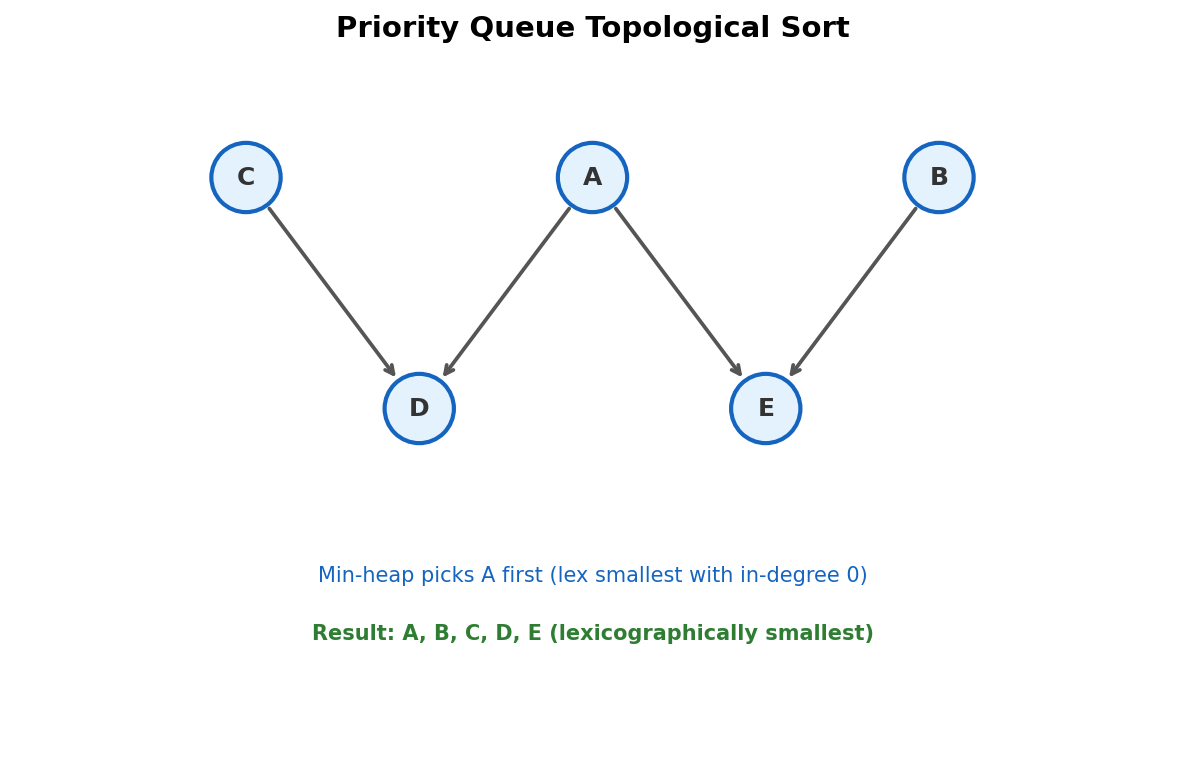
Standard Kahn's gives some valid topological order. But what if the problem demands the lexicographically smallest one? You can't just sort the output -- that would violate dependency constraints.
The fix is exactly one line of change: swap the queue for a min-heap. But understanding why this works (and why the DFS approach fails here) separates people who memorize from people who understand.
Why a Queue Isn't Enough
In standard Kahn's, when multiple nodes have in-degree 0 simultaneously, the queue processes them in FIFO order -- whichever happened to reach in-degree 0 first. That's arbitrary. It doesn't guarantee lexicographic order.
Consider nodes {3, 1, 5} all at in-degree 0. A queue might pop them in order 3, 1, 5. But lex-smallest needs 1 first.
Solution: Replace the queue with a min-priority-queue (min-heap). At every step, pop the smallest available node.
priority_queue<int, vector<int>, greater<int>> pq;
for (int i = 1; i <= n; i++)
    if (indeg[i] == 0) pq.push(i);

vector<int> order;
while (!pq.empty()) {
    int u = pq.top(); pq.pop();
    order.push_back(u);
    for (int v : adj[u])
        if (--indeg[v] == 0) pq.push(v);
}
That's it. Identical to Kahn's, with priority_queue instead of queue.
Greedy Correctness
Why does always picking the smallest available node produce the lex-smallest ordering?
Think about it position by position. For position 0, we want the smallest node that can legally go first. That's the smallest node with in-degree 0. After placing it, for position 1, we want the smallest node with in-degree 0 in the remaining graph. And so on.
At each step, the min-heap gives us exactly that node. No future choice can improve on picking the smallest available node now.
💡 Key insight. Lex-smallest topological order is a greedy algorithm. At every position, pick the smallest node whose prerequisites are all satisfied. The min-heap makes this efficient.
Trace on an Example
DAG: 1:[3], 2:[3], 4:[5], 3:[5], 5:[]
Nodes: {1, 2, 3, 4, 5}
Initial in-degrees: 1:0, 2:0, 3:2, 4:0, 5:2
| Step | Heap | Pop | Decrement | Order |
|---|---|---|---|---|
| 0 | {1, 2, 4} | -- | -- | [] |
| 1 | {2, 4} | 1 | 3→1 | [1] |
| 2 | {4} | 2 | 3→0, push 3 | [1, 2] |
| 3 | {4} | 3 | 5→1 | [1, 2, 3] |
| 4 | {} | 4 | 5→0, push 5 | [1, 2, 3, 4] |
| 5 | {} | 5 | -- | [1, 2, 3, 4, 5] |
Result: 1 2 3 4 5.
What would standard Kahn's (FIFO queue, seeded as {1, 2, 4}) give? Possibly 1 2 4 3 5 -- which is valid but not lex-smallest.
Why DFS Doesn't Work Here
You might think: run DFS in sorted neighbor order, take the reversed post-order. This does NOT produce the lex-smallest topological order.
Consider: 2 → 1, 3 → 1. DFS from node 2 first gives post-order [1, 2], then DFS from 3 gives [3]. Reversed: [3, 2, 1]. But the lex-smallest order is [2, 3, 1].
The problem is that DFS commits to exploring one branch fully before considering alternatives. It can't make the globally greedy choice at each position.
⚠ Gotcha. DFS-based topological sort with sorted neighbors does NOT produce lex-smallest order. Only the priority-queue Kahn's approach works. This is a common trap in contests.
AtCoder abc223_d -- Restricted Permutation
Problem: Given N items and M constraints "item A must come before item B," find the lexicographically smallest valid permutation. If impossible, print -1.
This maps directly to lex-smallest topological order:
#include <bits/stdc++.h>
using namespace std;

int main() {
    int n, m;
    cin >> n >> m;
    vector<int> adj[n + 1];
    vector<int> indeg(n + 1, 0);

    for (int i = 0; i < m; i++) {
        int a, b;
        cin >> a >> b;
        adj[a].push_back(b);
        indeg[b]++;
    }

    priority_queue<int, vector<int>, greater<int>> pq;
    for (int i = 1; i <= n; i++)
        if (indeg[i] == 0) pq.push(i);

    vector<int> order;
    while (!pq.empty()) {
        int u = pq.top(); pq.pop();
        order.push_back(u);
        for (int v : adj[u])
            if (--indeg[v] == 0) pq.push(v);
    }

    if ((int)order.size() < n) {
        cout << -1 << endl;
    } else {
        for (int i = 0; i < n; i++)
            cout << order[i] << (i + 1 < n ? " " : "\n");
    }
}
Checking Uniqueness (abc291_e)
Sometimes the question is: "Is the topological order unique?"
Rule: The topological order is unique if and only if the queue/heap never contains more than one element at any point during Kahn's algorithm.
If the queue ever has 2+ elements, we had a choice. A choice means multiple valid orderings.
bool unique = true;
priority_queue<int, vector<int>, greater<int>> pq;
for (int i = 1; i <= n; i++)
    if (indeg[i] == 0) pq.push(i);

vector<int> order;
while (!pq.empty()) {
    if (pq.size() > 1) unique = false;
    int u = pq.top(); pq.pop();
    order.push_back(u);
    for (int v : adj[u])
        if (--indeg[v] == 0) pq.push(v);
}
💡 Key insight. Uniqueness of topological order = the DAG has a Hamiltonian path. At every step exactly one node is available. This is equivalent to checking that the queue size never exceeds 1.
Uniqueness Trace
DAG: 1 → 2 → 3 → 4 (a chain)
| Step | Heap | Size | Unique? |
|---|---|---|---|
| 0 | {1} | 1 | Yes |
| 1 | {2} | 1 | Yes |
| 2 | {3} | 1 | Yes |
| 3 | {4} | 1 | Yes |
Unique: Yes.
Now add node 5 with no edges (isolated):
| Step | Heap | Size | Unique? |
|---|---|---|---|
| 0 | {1, 5} | 2 | No |
| 1 | {2, 5} | 2 | No |
We could put 5 before 1, between 1 and 2, etc. Multiple valid orderings.
Complexity
The min-heap adds a log factor:
- Time: O((V + E) log V). Each push/pop on the heap costs O(log V). We do at most V pushes and V pops, plus E edge relaxations.
- Space: O(V) for the heap and in-degree array.
For most problems, V and E are up to 2 * 10^5, so the log factor is negligible.
Try It
The starter code is set up for lex-smallest ordering. Fill in the heap operations.
Test case 1:
Test case 2:
Test case 3 -- cycle:
Challenge: For the lex-largest topological order, would you use a max-heap? Yes. Think about why the same greedy argument applies in reverse.
Problems
| Problem | Link | Difficulty |
|---|---|---|
| AtCoder abc223_d — Restricted Permutation | atcoder.jp/contests/abc223/tasks/abc223_d | Medium |
| AtCoder abc291_e — Find Permutation | atcoder.jp/contests/abc291/tasks/abc291_e | Medium |
| LC 210 — Course Schedule II | leetcode.com/problems/course-schedule-ii | Medium |