Monotonic Stack on Trees
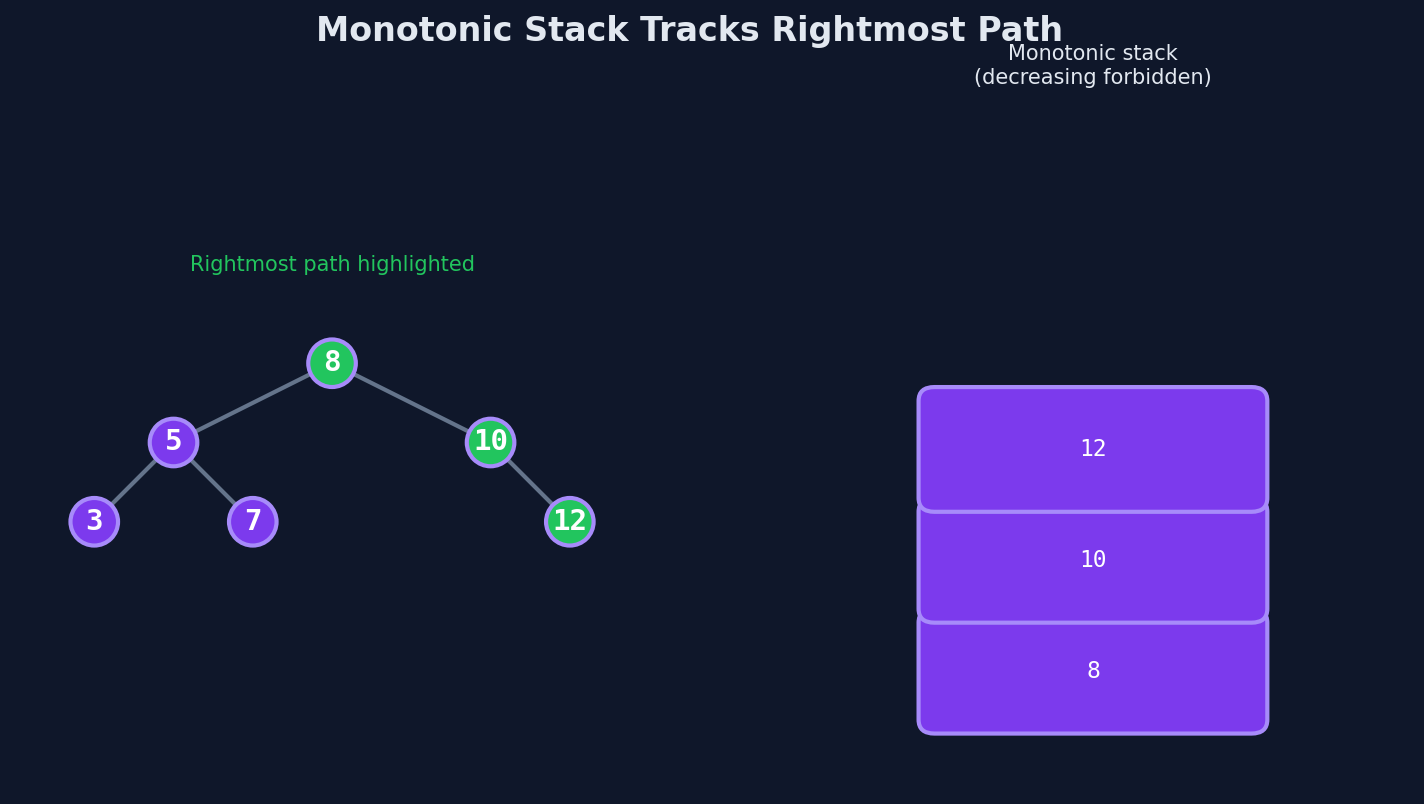
The Same Tool, Different Shape
In array problems, a monotonic stack processes elements left-to-right, maintaining a sorted invariant. The stack answers questions like "what's the next greater element?" in \(O(n)\).
On trees, the same idea works. The difference: instead of processing a flat sequence, you're processing a traversal sequence. The stack maintains a structural invariant related to the tree — typically the rightmost path from root to the current insertion point.
The Problem: Build a BST from Preorder
LC 1008. Given the preorder traversal of a BST, reconstruct the tree.
Input: [8, 5, 1, 7, 10, 12]
Expected BST:
The brute force: For each element, walk down the tree to find where it belongs. That's \(O(n \cdot h)\), which is \(O(n^2)\) for a skewed tree.
The monotonic stack approach: \(O(n)\).
Why Preorder + BST = Monotonic Stack
In preorder, you visit the root first, then the left subtree, then the right subtree. In a BST, left children are smaller and right children are larger.
So in the preorder sequence [8, 5, 1, 7, 10, 12]:
- 8 is the root
- 5 < 8, so 5 is in the left subtree of 8
- 1 < 5, so 1 is in the left subtree of 5
- 7 > 1 and 7 > 5? No, 7 > 1 but 7 < 8. So 7 is the right child of 5.
- 10 > 8, so 10 is in the right subtree of 8
- 12 > 10, so 12 is in the right subtree of 10
The key observation: at any point, the stack holds the rightmost path of the tree built so far (from root down to the most recently added node). When a new value arrives:
- If it's smaller than the stack top: it's the left child of the top.
- If it's larger than the stack top: pop nodes until you find a node larger than the new value (or the stack empties). The last popped node becomes the parent — the new value is its right child.
This is a monotonic stack. The stack maintains a decreasing sequence (from bottom to top) at all times — which is exactly the rightmost path of a BST during construction.
Full Trace
Input: [8, 5, 1, 7, 10, 12]
| Step | Value | Stack (bottom→top) | Action | Tree edge created |
|---|---|---|---|---|
| 1 | 8 | [8] | Create root | — |
| 2 | 5 | [8, 5] | 5 < 8 → left child of 8 | 8.left = 5 |
| 3 | 1 | [8, 5, 1] | 1 < 5 → left child of 5 | 5.left = 1 |
| 4 | 7 | Pop 1 (7>1), pop 5 (7>5). Stop at 8 (7<8). Last popped = 5. Push 7. → [8, 7] | right child of 5 | 5.right = 7 |
| 5 | 10 | Pop 7 (10>7), pop 8 (10>8). Stack empty. Last popped = 8. Push 10. → [10] | right child of 8 | 8.right = 10 |
| 6 | 12 | Pop 10 (12>10). Stack empty. Last popped = 10. Push 12. → [12] | right child of 10 | 10.right = 12 |
Result tree:
Verify via inorder: 1, 5, 7, 8, 10, 12. Sorted. Correct BST.
Why the Stack IS the Rightmost Path
After step 3, the stack is [8, 5, 1]. The tree so far:
The rightmost path from root: 8 → 5 → 1. That's exactly the stack, bottom to top.
After step 4 (inserting 7), we pop 1 and 5 (both < 7), making 7 the right child of 5. Stack becomes [8, 7]:
Rightmost path: 8 → 5 → 7? No — the rightmost path from root is 8, and then... 8's right child doesn't exist yet. The stack [8, 7] represents the candidates for being the parent of the next node: 8 and 7, where 7 is the deepest rightmost node.
The stack always holds the nodes on the path from root to the current rightmost leaf, pruned to only include nodes that could still receive a right child.
The monotonic stack on a tree tracks the rightmost path. Popping = "this node's right subtree is complete." Pushing = "extending the rightmost path deeper."
The Code
TreeNode* bstFromPreorder(vector<int>& preorder) {
    TreeNode* root = new TreeNode(preorder[0]);
    stack<TreeNode*> rightmostPath;
    rightmostPath.push(root);

    for (int i = 1; i < (int)preorder.size(); i++) {
        TreeNode* newNode = new TreeNode(preorder[i]);

        if (preorder[i] < rightmostPath.top()->val) {
            rightmostPath.top()->left = newNode;
        } else {
            TreeNode* lastPopped = nullptr;
            while (!rightmostPath.empty() && preorder[i] > rightmostPath.top()->val) {
                lastPopped = rightmostPath.top();
                rightmostPath.pop();
            }
            lastPopped->right = newNode;
        }

        rightmostPath.push(newNode);
    }

    return root;
}
Complexity: \(O(n)\) time (each node is pushed and popped at most once), \(O(n)\) space.
Connection to Array Monotonic Stacks
In the "next greater element" array problem, you maintain a decreasing stack. When a new element is larger, you pop — and each popped element's "next greater" is the new element.
Here, the same thing happens structurally. When a new BST value is larger than the stack top, you pop — and each popped node's subtree is "completed" (no more right children will be added to it).
| Array Mono-Stack | Tree Mono-Stack |
|---|---|
| Stack = unsolved elements waiting for a greater value | Stack = rightmost path nodes waiting for a right child |
| Pop = this element found its next greater | Pop = this node's right subtree is now finalized |
| Push = new element enters the "waiting" pool | Push = extending the rightmost path |
The mental model transfers directly. If you understand monotonic stacks on arrays, you understand them on trees — the underlying mechanism is identical.
Try It
Predict before running: What if the preorder is sorted in decreasing order, like [5, 4, 3, 2, 1]? Every value is smaller than the top, so it always becomes a left child. You get a left-skewed tree. The stack grows to size \(n\). No pops until... actually no pops at all.
Challenge: What if the preorder is sorted in increasing order, like [1, 2, 3, 4, 5]? Each value pops everything, then pushes. You get a right-skewed tree.
Challenge 2: Can you construct a BST from postorder traversal using a similar approach? Think about processing the postorder array from right to left.
Edge Cases to Watch For
- Sorted ascending input (e.g.,
[1, 2, 3, 4, 5]): every new value pops the entire stack, producing a right-skewed BST. The last popped node becomes the new node's left child — if your code doesn't track the last popped node, the left subtree is lost. - Sorted descending input (e.g.,
[5, 4, 3, 2, 1]): every new value is smaller than the top, so it always becomes a left child with zero pops. Tests that the "no pop" path correctly attaches the node. - Duplicate values: Not valid for a BST preorder (BST keys are unique), but if encountered, the
>vs.>=comparison must be consistent with the BST definition used. Getting this wrong places nodes on the wrong side.
Problems
| Problem | Link | Difficulty |
|---|---|---|
| LC 1008 — Construct BST from Preorder Traversal | leetcode.com/problems/construct-binary-search-tree-from-preorder-traversal | Medium |
| LC 654 — Maximum Binary Tree | leetcode.com/problems/maximum-binary-tree | Medium |
| LC 739 — Daily Temperatures | leetcode.com/problems/daily-temperatures | Medium |