Coverage Problems
The "Place as Far Right as Possible" Principle
Coverage problems have a recurring structure: you need to cover every "bad" position, and you can place coverers. The greedy insight is always the same:
When you find the leftmost uncovered position, place your coverage as far right as possible while still covering it.
This maximizes how far your coverage extends, giving the best possible start for the next decision.
The Problem That Forces This
CF2034B — Rakhsh's Revival: Binary string s of length \(n\). The rule: no \(k\) consecutive 0s are allowed. If you find \(k\) consecutive zeros, you can perform one operation: choose any contiguous segment of length \(m\) and set all characters to 1. Find the minimum number of operations.
The Greedy Choice: When forced to patch, place the patch as far right as possible. This maximizes how much future ground you skip.
You're forced to act whenever you see \(k\) consecutive zeros. Once forced, where should you place the length-\(m\) patch?
Wrong Approach: Patch at the Start of the Run
Suppose you find \(k\) consecutive zeros starting at position \(i\). You could place the patch starting at position \(i\) (covering \(i\) to \(i+m-1\)).
Example: \(n=10\), \(k=3\), \(m=4\), s=0000000000 (all zeros).
Patch starting at position 0: covers 0-3. String: 1111000000. Zeros from 4 onward.
Next \(k\) consecutive zeros: at position 4. Patch at 4: covers 4-7. String: 1111111100. Still two zeros from 8.
Next: patch at 8. Covers 8-9 (partially). String: 1111111111. Done. 3 patches.
What if we patch at the END of each streak instead?
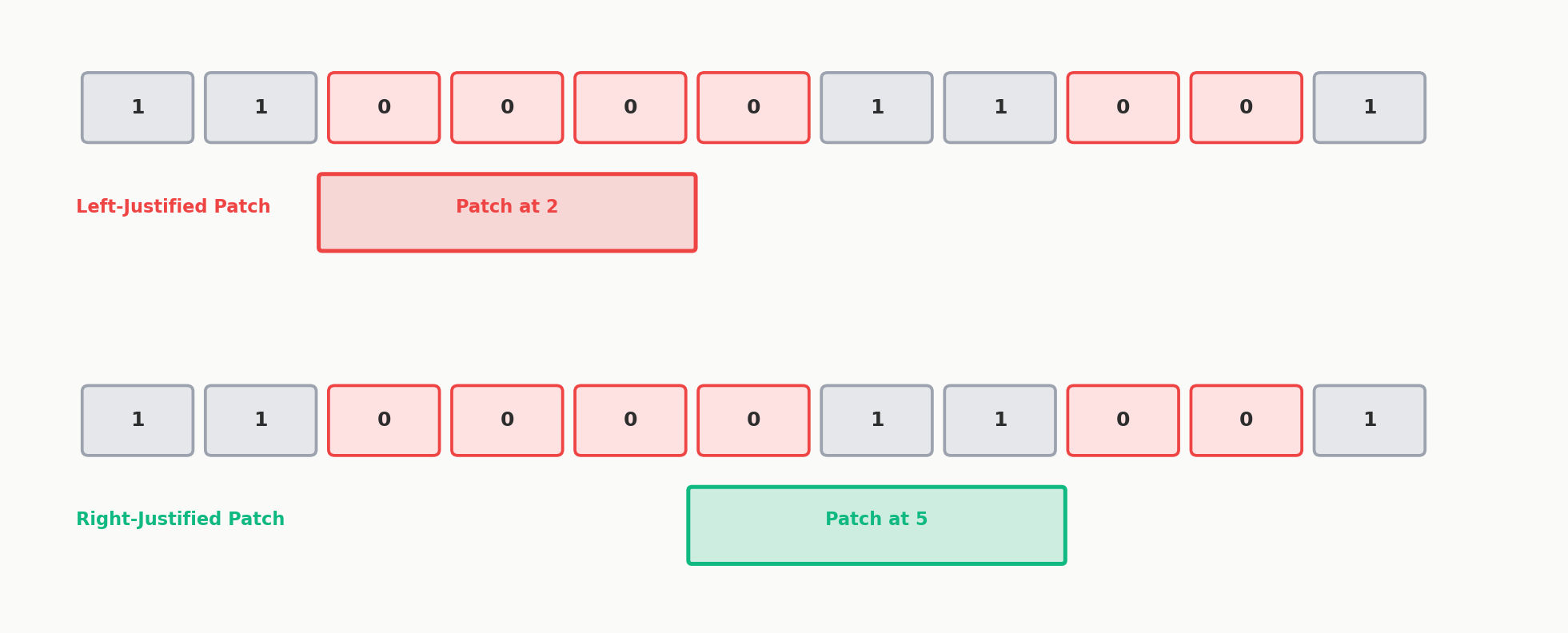
Scan left to right, counting consecutive zeros. At position 2, we've seen 3 consecutive zeros — that's \(k\). Patch here: covers positions 2-5. String: 0011110000. Positions 0-1 are still zero, but only 2 in a row — less than \(k\), so fine. Reset the counter and continue from position 6.
At position 8 (two more zeros from 6,7, then the third at 8), the counter hits \(k\) again. Patch: covers 8-11. String: 0011110011. Positions 6-7 are zero, but only 2 — fine. 2 patches. Better!
The rightmost placement skips more future ground.
The Correct Greedy
The key insight: don't count entire blocks of zeros at once. Instead, scan character by character, maintaining a running tally of consecutive zeros.
- If
s[i] == '1': reset the tally to 0. Move to \(i+1\). - If
s[i] == '0': increment the tally. - If the tally reaches \(k\): we're forced to patch. The patch starts at position \(i\) (the \(k\)-th zero) and covers \(m\) characters. Increment patches, jump \(i\) forward by \(m\), reset the tally to 0.
- Otherwise: move to \(i+1\).
Why this is optimal: When forced to act (the \(k\)-th consecutive zero), we place the patch starting at the exact trigger position. This means the patch extends as far right as possible — covering the \(k\)-th zero plus \(m-1\) additional positions. Any earlier placement would waste patch coverage on positions we've already scanned past.
Stays-ahead argument: After each patch, greedy's "next unprotected position" is at least as far right as any other strategy's. This is because greedy waits until the last possible moment (the \(k\)-th zero) before patching, then patches as far right as it can.
Tracing the Algorithm
\(n=12\), \(k=3\), \(m=4\), s=000100000011:
| \(i\) | s[\(i\)] | consecutiveZeros | Hits \(k\)? | Action | patchesUsed |
|---|---|---|---|---|---|
| 0 | 0 | 1 | No | \(i\)++ | 0 |
| 1 | 0 | 2 | No | \(i\)++ | 0 |
| 2 | 0 | 3 | Yes | Patch! Skip to \(i = 2 + 4 = 6\), reset tally | 1 |
| 6 | 0 | 1 | No | \(i\)++ | 1 |
| 7 | 0 | 2 | No | \(i\)++ | 1 |
| 8 | 0 | 3 | Yes | Patch! Skip to \(i = 8 + 4 = 12\), reset tally | 2 |
| 12 | end | — | — | Done | 2 |
2 patches. Let's verify: original 000100000011. After patch at 2 (covers 2-5): 001111000011. After patch at 8 (covers 8-11): 001111001111. No run of 3 consecutive zeros anywhere. ✓
Note what happened at positions 3 and 4: the original 1 at position 3 and the 0 at position 4 were both overwritten by the first patch. The character-by-character scan didn't need to see them — the patch jumped right over them.
Example 2: HR Hackerland Radio Transmitters
Problem: Houses at positions \(x_1, \ldots, x_n\) on a 1D line. Each transmitter covers all houses within distance \(k\) (a transmitter at position \(p\) covers \([p-k, p+k]\)). Transmitters must be placed AT existing house positions. Find minimum transmitters to cover all houses.
Greedy: 1. Sort houses. 2. Find the leftmost uncovered house at position \(h\). 3. Place a transmitter at \(h + k\) (the furthest position that still covers \(h\)). 4. All houses within \(k\) of \(h + k\) are now covered — skip them. 5. Repeat.
Why place at \(h + k\)? The leftmost house \(h\) MUST be covered, so the transmitter must be in \([h, h + k]\) (within \(k\) of \(h\)). Of all positions in this range, \(h + k\) covers the furthest right — giving maximum coverage of future houses.
Stays-ahead proof: After \(j\) transmitters, greedy's coverage extends at least as far right as any other placement with \(j\) transmitters. This is because greedy always places as far right as feasibly possible. At every step, greedy is "ahead" in coverage. So greedy needs at most as many transmitters as any other approach.
Tracing the Transmitter Algorithm
Houses at: 1, 3, 5, 8, 12, 15, 17. \(k = 2\).
Sorted: 1, 3, 5, 8, 12, 15, 17.
| Step | Leftmost uncovered | Transmitter at | Covers up to | Houses covered |
|---|---|---|---|---|
| 1 | 1 | \(1+2=3\) | \(3+2=5\) | 1, 3, 5 |
| 2 | 8 | \(8+2=10\) | \(10+2=12\) | 8, 12 |
| 3 | 15 | \(15+2=17\) | \(17+2=19\) | 15, 17 |
3 transmitters.
Could we do it in 2? - One transmitter at position 3: covers \([1,5]\) = houses 1, 3, 5. - One transmitter at position 14: covers \([12,16]\) = houses 12, 15. But house 8 and 17 are uncovered.
No, 2 transmitters can't cover all 7 houses spread over distance 17. 3 is optimal.
The Difference Between Coverage and Interval Piercing
At first glance these look similar. The key difference:
| Problem | You have | You place | Goal |
|---|---|---|---|
| Interval piercing | Intervals to "hit" | Points (zero-width) | Min points |
| Coverage | Positions to cover | Ranges (width \(2k\)) | Min ranges |
Both use "sort + greedy place as far right as possible," but for different reasons: - Piercing: one point hits multiple intervals that all contain that point - Coverage: one transmitter covers a contiguous range of positions
The Full Code (Rakhsh's Revival)
#include <bits/stdc++.h>
using namespace std;

int main() {
    ios_base::sync_with_stdio(false);
    cin.tie(NULL);

    int numChars, consecutiveZeroLimit, patchSize;
    cin >> numChars >> consecutiveZeroLimit >> patchSize;

    string s;
    cin >> s;

    int patchesUsed = 0;
    int consecutiveZeros = 0;

    for (int i = 0; i < numChars; ) {
        if (s[i] == '0') {
            consecutiveZeros++;
            if (consecutiveZeros == consecutiveZeroLimit) {
                patchesUsed++;
                i += patchSize;
                consecutiveZeros = 0;
                continue;
            }
        } else {
            consecutiveZeros = 0;
        }
        i++;
    }

    cout << patchesUsed << "\n";
    return 0;
}
The logic is simple: scan character by character, count consecutive zeros, patch when the count reaches \(k\). The patch jumps \(i\) forward by \(m\) (the patch covers the trigger position plus \(m-1\) more), and the zero counter resets because the patch broke the streak.
Try It
Trace: - \(i=0,1\): zeros accumulate to 2. - \(i=2\): third zero, tally hits \(k=3\). Patch! Jump to \(i=2+4=6\). Reset tally. patches=1. - \(i=6,7\): zeros accumulate to 2. - \(i=8\): third zero, tally hits \(k=3\). Patch! Jump to \(i=8+4=12\). patches=2. - \(i=12\): end. 2 patches.
Trace: s=001000. Indices: 0='0', 1='0', 2='1', 3='0', 4='0', 5='0'.
- \(i=0\): zero, tally=1.
- \(i=1\): zero, tally=2 \(= k\). Patch! Jump to \(i=1+3=4\). Reset tally. patches=1.
- \(i=4\): zero, tally=1.
- \(i=5\): zero, tally=2 \(= k\). Patch! Jump to \(i=5+3=8\). patches=2.
- Done. 2 patches.
Both streaks of \(\geq k\) zeros need separate patches. The 1 at position 2 breaks the first streak, but each half independently reaches \(k\).
Challenge: Construct an input where the answer is 1 and verify with the algorithm. (Hint: make \(m\) large enough to cover all remaining zeros after the first trigger.)
Problems
| Problem | Link | Difficulty |
|---|---|---|
| CF2034B — Rakhsh's Revival | codeforces.com/problemset/problem/2034/B | 1100 |
| HR — Hackerland Radio Transmitters | hackerrank.com/challenges/hackerland-radio-transmitters | Medium |