Merge, Two Sum, Largest BST
Three Problems, Three Patterns
This lesson covers three BST problems that each connect back to a technique you already know. The goal: recognize the underlying pattern so you're not memorizing solutions — you're deriving them.
Problem 1: Merge Two BSTs
Given two BSTs, produce a single balanced BST containing all values from both.
You can't just insert every node from one tree into the other — that could give you a skewed tree. And even if it didn't, it's \(O(n \log n)\) per tree.
The approach that works: flatten both BSTs into sorted arrays (inorder traversal), merge the two sorted arrays (exactly like the merge step of merge sort), then build a balanced BST from the merged sorted array.
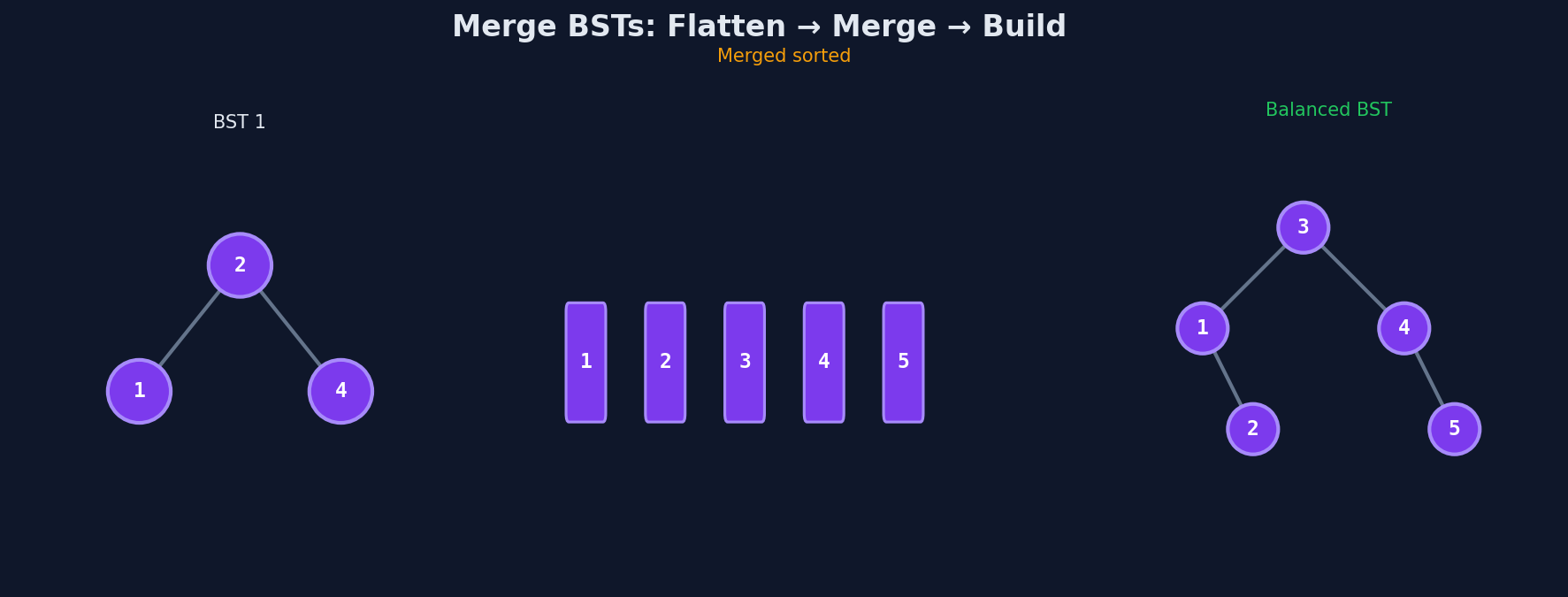
Step-by-Step
Tree A:
Tree B:
Step 1: Flatten via inorder.
Tree A → [1, 3, 5]
Tree B → [2, 4, 6]
Step 2: Merge two sorted arrays.
| Pointer A | Pointer B | Pick | Merged so far |
|---|---|---|---|
| 1 | 2 | 1 | [1] |
| 3 | 2 | 2 | [1, 2] |
| 3 | 4 | 3 | [1, 2, 3] |
| 5 | 4 | 4 | [1, 2, 3, 4] |
| 5 | 6 | 5 | [1, 2, 3, 4, 5] |
| — | 6 | 6 | [1, 2, 3, 4, 5, 6] |
Step 3: Build balanced BST from sorted array. Pick the middle element as root, recurse on left half and right half.
Sorted: [1, 2, 3, 4, 5, 6]. Middle index = 2 → root = 3.
Left half [1, 2] → middle = 1, right child 2.
Right half [4, 5, 6] → middle = 5, left child 4, right child 6.
Balanced. All values present. BST property holds.
The Code
void flattenToSorted(TreeNode* root, vector<int>& result) {
    if (!root) return;
    flattenToSorted(root->left, result);
    result.push_back(root->value);
    flattenToSorted(root->right, result);
}

vector<int> mergeSortedArrays(vector<int>& first, vector<int>& second) {
    vector<int> merged;
    int indexFirst = 0, indexSecond = 0;
    while (indexFirst < (int)first.size() && indexSecond < (int)second.size()) {
        if (first[indexFirst] <= second[indexSecond])
            merged.push_back(first[indexFirst++]);
        else
            merged.push_back(second[indexSecond++]);
    }
    while (indexFirst < (int)first.size()) merged.push_back(first[indexFirst++]);
    while (indexSecond < (int)second.size()) merged.push_back(second[indexSecond++]);
    return merged;
}

TreeNode* buildBalancedBST(vector<int>& sortedValues, int start, int end) {
    if (start > end) return nullptr;
    int mid = start + (end - start) / 2;
    TreeNode* node = new TreeNode(sortedValues[mid]);
    node->left = buildBalancedBST(sortedValues, start, mid - 1);
    node->right = buildBalancedBST(sortedValues, mid + 1, end);
    return node;
}
Complexity: \(O(n + m)\) time and space, where \(n\) and \(m\) are the sizes of the two trees.
Problem 2: Two Sum in BST (LC 653)
Problem: Given a BST and a target sum, determine if any two nodes have values that add up to the target.
The brute force: for every node, search the BST for target - node.value. That's \(O(n \log n)\) for a balanced tree.
The better approach: use the BST's sorted order. Flatten to a sorted array, then use two pointers — one from the start, one from the end — exactly like Two Sum on a sorted array.
But there's an even cleaner approach that skips the array entirely: use two BST iterators. One walks forward (smallest to largest), the other walks backward (largest to smallest). This is a controlled inorder traversal — the same iterative inorder from the previous lesson, but you advance each iterator one step at a time.
Trace: Target = 9
| Left Pointer | Right Pointer | Sum | Action |
|---|---|---|---|
| 2 | 8 | 10 | \(10 > 9\) → move right pointer back |
| 2 | 7 | 9 | Found |
Two steps. Done.
The Code (Array + Two Pointers)
bool findTwoSumBST(TreeNode* root, int target) {
    vector<int> sortedValues;
    flattenToSorted(root, sortedValues);

    int leftIndex = 0;
    int rightIndex = (int)sortedValues.size() - 1;

    while (leftIndex < rightIndex) {
        int currentSum = sortedValues[leftIndex] + sortedValues[rightIndex];
        if (currentSum == target) return true;
        if (currentSum < target) leftIndex++;
        else rightIndex--;
    }
    return false;
}
Complexity: \(O(n)\) time, \(O(n)\) space.
The BST iterator approach achieves \(O(n)\) time with \(O(h)\) space — you maintain two stacks of height \(h\) instead of materializing the whole array. Worth implementing if space matters.
Problem 3: Largest BST in Binary Tree (LC 333)
Problem: Given a binary tree (not necessarily a BST), find the size of the largest subtree that IS a valid BST.
This is the most interesting problem here because it's NOT a BST-specific technique. It's a postorder pair-return problem from Chapter 3.
Is the entire tree a BST? No — 8 is in the left subtree of 10 but 8 < 10 is fine. And 15 is in the right subtree. Actually, wait — let's check. Inorder: 1, 5, 8, 10, 15, 20. That IS sorted. This whole tree IS a valid BST.
Try a trickier example:
Node 6 is in the right subtree of 10, but 6 < 10. Invalid. The largest BST subtrees are 5(1, 8) with size 3, and 20 with size 1. Answer: 3.
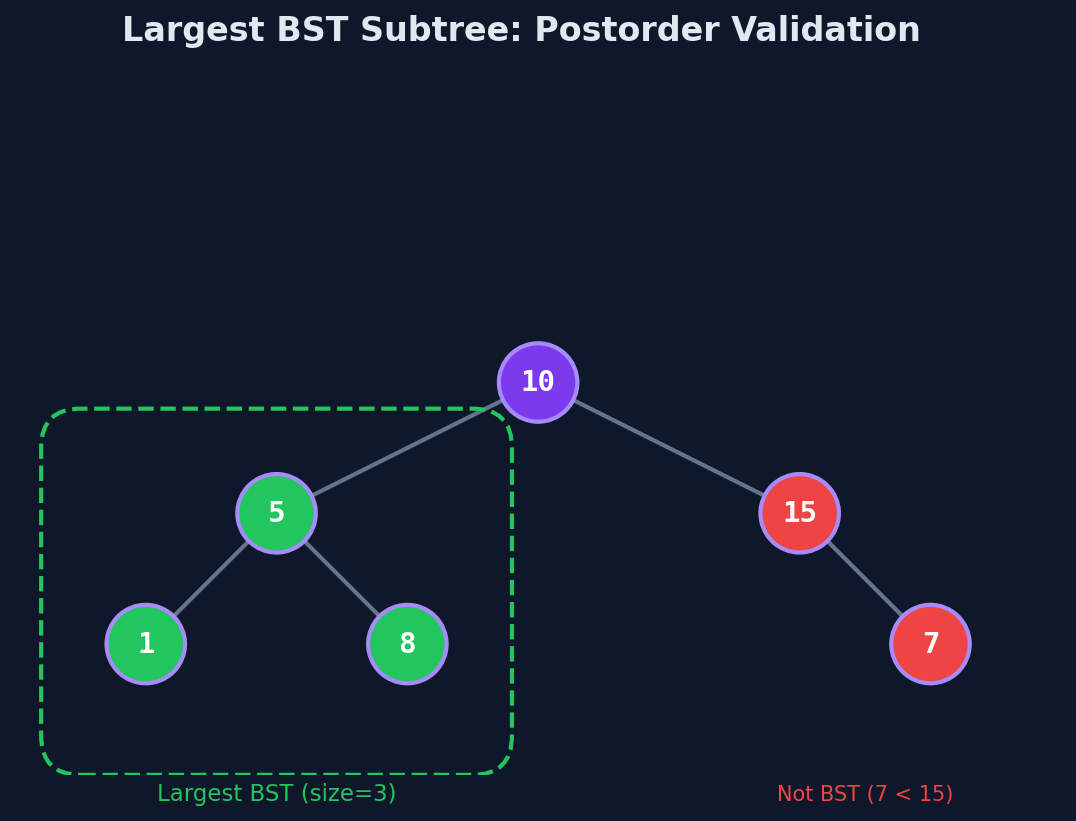
The Postorder Pattern
At each node, you need to know about your children before you can decide about yourself. That's postorder.
What information do you need from each subtree?
- Is it a valid BST?
- Its size (if it's a valid BST)
- The minimum value in the subtree
- The maximum value in the subtree
A node's subtree is a valid BST if: - Left subtree is a valid BST - Right subtree is a valid BST - Left subtree's max < current node's value - Right subtree's min > current node's value
If all four conditions hold, the current subtree is a valid BST with size = 1 + leftSize + rightSize. If not, pass up the larger of the two children's BST sizes.
Full Trace
| Node | Left returns | Right returns | isBST? | Size | Min | Max |
|---|---|---|---|---|---|---|
| 1 | (true, 0, inf, -inf) | (true, 0, inf, -inf) | Yes | 1 | 1 | 1 |
| 8 | (true, 0, inf, -inf) | (true, 0, inf, -inf) | Yes | 1 | 8 | 8 |
| 5 | (true, 1, 1, 1) | (true, 1, 8, 8) | \(1 < 5\) and \(8 > 5\)? Yes, but wait — \(8 > 5\) means left max < node. Check: leftMax=1 < 5, rightMin=8 > 5. Yes | 3 | 1 | 8 |
| 6 | (true, 0, inf, -inf) | (true, 0, inf, -inf) | Yes | 1 | 6 | 6 |
| 20 | (true, 0, inf, -inf) | (true, 0, inf, -inf) | Yes | 1 | 20 | 20 |
| 15 | (true, 1, 6, 6) | (true, 1, 20, 20) | leftMax=6 < 15? No! \(6 < 15\) is true. rightMin=20 > 15? Yes. Yes | 3 | 6 | 20 |
| 10 | (true, 3, 1, 8) | (true, 3, 6, 20) | leftMax=8 < 10? Yes. rightMin=6 > 10? No! | Not BST | — | — |
Node 10 fails because 6 (min of right subtree) is less than 10. The largest BST subtrees are size 3 (rooted at 5 and rooted at 15). Answer: 3.
The Code
struct BSTInfo {
    bool isBST;
    int size;
    int minValue;
    int maxValue;
};

BSTInfo findLargestBST(TreeNode* root, int& largestSize) {
    if (!root) return {true, 0, INT_MAX, INT_MIN};

    BSTInfo leftInfo = findLargestBST(root->left, largestSize);
    BSTInfo rightInfo = findLargestBST(root->right, largestSize);

    if (leftInfo.isBST && rightInfo.isBST &&
        leftInfo.maxValue < root->value &&
        rightInfo.minValue > root->value) {

        int currentSize = 1 + leftInfo.size + rightInfo.size;
        largestSize = max(largestSize, currentSize);

        int currentMin = leftInfo.size == 0 ? root->value : leftInfo.minValue;
        int currentMax = rightInfo.size == 0 ? root->value : rightInfo.maxValue;

        return {true, currentSize, currentMin, currentMax};
    }

    return {false, 0, 0, 0};
}
If you solved Chapter 3's pair-return problems, this should feel familiar. The struct
BSTInfois your multi-value return. The postorder structure is identical — process children first, combine at the current node.
Complexity: \(O(n)\) time, \(O(h)\) space.
Try It
The starter code has a findTwoSumBST function with a TODO. The tree has values 2, 3, 4, 5, 6, 7, 8 and the target is 9.
Predict before running: Which pairs sum to 9? 2+7, 3+6, 4+5. The function should return true.
Challenge: In the merge problem, what happens if the two BSTs have duplicate values? Does the algorithm still work? (Yes — the merge step handles equal elements correctly, and the resulting BST can have duplicates if you allow <= in the BST property.)
Challenge 2: Can you solve Two Sum in BST with \(O(h)\) space instead of \(O(n)\)? (Hint: use two stacks — one for forward inorder, one for reverse inorder.)
Edge Cases to Watch For
- Two Sum with target that equals double the root: For example, tree has root 5 and target = 10. You need two DISTINCT nodes summing to 10, not the same node twice. The two-pointer approach handles this because
leftIndex < rightIndexprevents using the same element. If you use a hash set approach instead, you must check that the two nodes are different.
Problems
| Problem | Link | Difficulty |
|---|---|---|
| LC 653 — Two Sum IV (BST) | leetcode.com/problems/two-sum-iv-input-is-a-bst | Easy |
| LC 108 — Convert Sorted Array to BST | leetcode.com/problems/convert-sorted-array-to-binary-search-tree | Easy |
| LC 333 — Largest BST Subtree | leetcode.com/problems/largest-bst-subtree | Medium |
| LC 1305 — All Elements in Two BSTs | leetcode.com/problems/all-elements-in-two-binary-search-trees | Medium |