Two-Source Combine
Product graphs cost O(N²). But many "two-sided" problems don't need them. Run two independent shortest-path computations and combine per vertex. O(V log V), not O(V² log V).
The Pattern
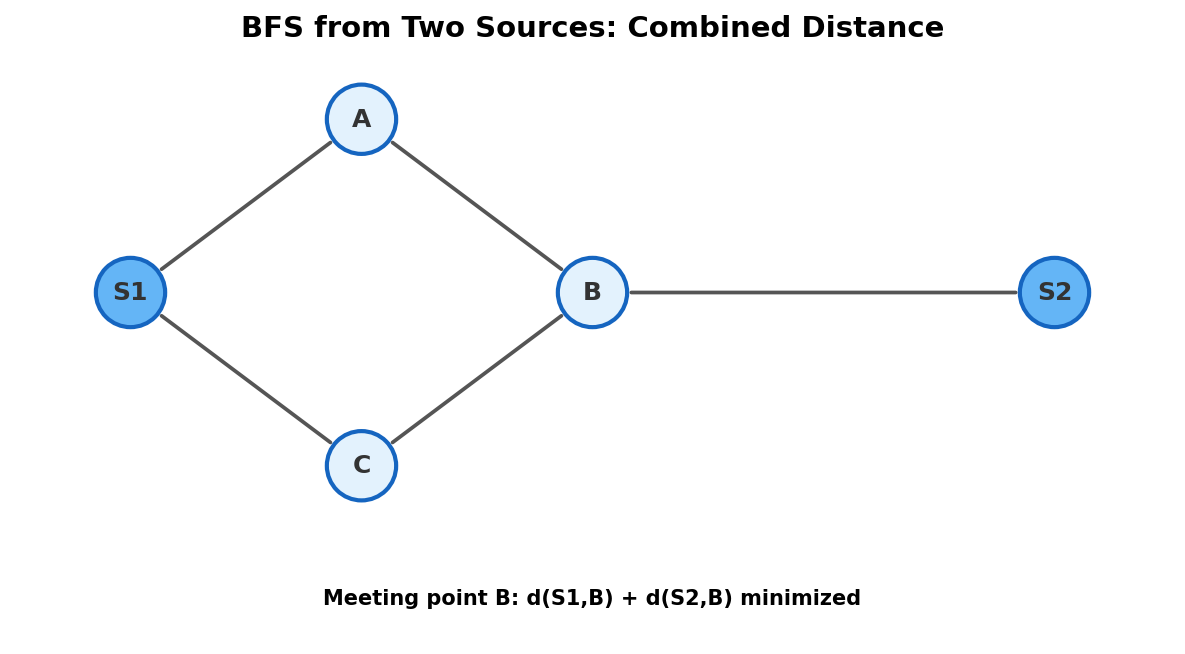
- Dijkstra from source S → dist_fwd[v] for all v.
- Dijkstra from target T on reversed graph → dist_rev[v] for all v.
- For each vertex v: shortest S → v → T = dist_fwd[v] + dist_rev[v].
Problem 1: Typical90 #13 — Passing
For each city v, find the shortest path from 1 to N that passes through v.
auto d1 = dijkstra(1, adj, n);
auto dn = dijkstra(n, radj, n);
for (int v = 1; v <= n; v++)
    cout << d1[v] + dn[v] << "\n";
Two Dijkstra runs. One line of combination.
Problem 2: ABC035-D — Treasure Hunt
Directed graph. Town i earns A[i] yen per minute. Start at town 1, return at exactly time T. Maximize earnings.
💡 Key insight. Travel to one town, stay the whole time collecting, travel back. Splitting across towns is never better.
| City v | A[v] | dist_fwd[v] | dist_rev[v] | Stay | Profit |
|---|---|---|---|---|---|
| 1 | 2 | 0 | 0 | 10 | 20 |
| 2 | 8 | 3 | 3 | 4 | 32 |
| 3 | 5 | 2 | 4 | 4 | 20 |
Answer = max over v of A[v] × (T - dist_fwd[v] - dist_rev[v]).
Problem 3: SoundHound 2018 D — Saving Snuuk
Two currency graphs (yen, snuuk). Exchange at one city. Offices close over time.
- Dijkstra from s using yen → dist_yen[v].
- Dijkstra from t using snuuk (reversed) → dist_snuuk[v].
- Profit at city v = 10^15 - dist_yen[v] - dist_snuuk[v].
- Suffix max sweep as offices close.
auto dy = dijkstra(s, adj_yen, n);
auto ds = dijkstra(t, radj_snuuk, n);
ll mx = -1e18;
for (int i = n; i >= 1; i--) {
    mx = max(mx, (ll)1e15 - dy[i] - ds[i]);
    cout << mx << "\n";
}
Two-Source vs Product Graph
| Two-Source | Product Graph | |
|---|---|---|
| States | O(V) | O(V²) |
| Use when | Agents move independently | Agents' moves are coupled |
| Example | "Best meeting point" | "Both must move each step" |
⚠ Gotcha. For directed graphs, the reverse Dijkstra runs on the reversed graph (all edges flipped). For undirected, same adjacency list works.
Exercises
- In Treasure Hunt, why is one-town-stay always optimal?
- Can you solve LC 1976 (Number of Ways to Arrive) with two-source combine?
- What if the graph has negative edges — does the pattern still work?
Problems
| Problem | Link | Difficulty |
|---|---|---|
| Typical90 #13 — Passing | atcoder.jp | Medium |
| ABC035-D — Treasure Hunt | atcoder.jp | Medium |
| SoundHound 2018 D | atcoder.jp | Hard |
| LC 1976 — Number of Ways | leetcode.com | Medium |