The Call Stack IS the Tree
What Actually Happens When You Recurse?
In the last lesson, we wrote countNodes and traced which calls happen and what they return. But we skipped something important: where does the computer store all those in-progress calls?
When countNodes(1) calls countNodes(2), node 1 isn't finished yet. It's waiting. When countNodes(2) calls countNodes(4), node 2 is also waiting. We now have three unfinished calls stacked on top of each other.
That stack of waiting calls is the call stack. And here's the thing that changes how you think about tree recursion:
At any moment during DFS, the call stack contains exactly the nodes on the path from the root to the current node.
Not some of them. Not an approximation. The call stack IS the root-to-current-node path. The computer is literally holding the path in memory for you, one frame per node.
A 7-Node Tree
We'll trace this tree for the rest of the lesson:
Seven nodes. The deepest path is \(1 \to 2 \to 4 \to 6\), which has depth 3 (three edges).
Frame-by-Frame Trace
We'll run a simple DFS that visits every node. At each step, we show the tree on the left and the call stack on the right.
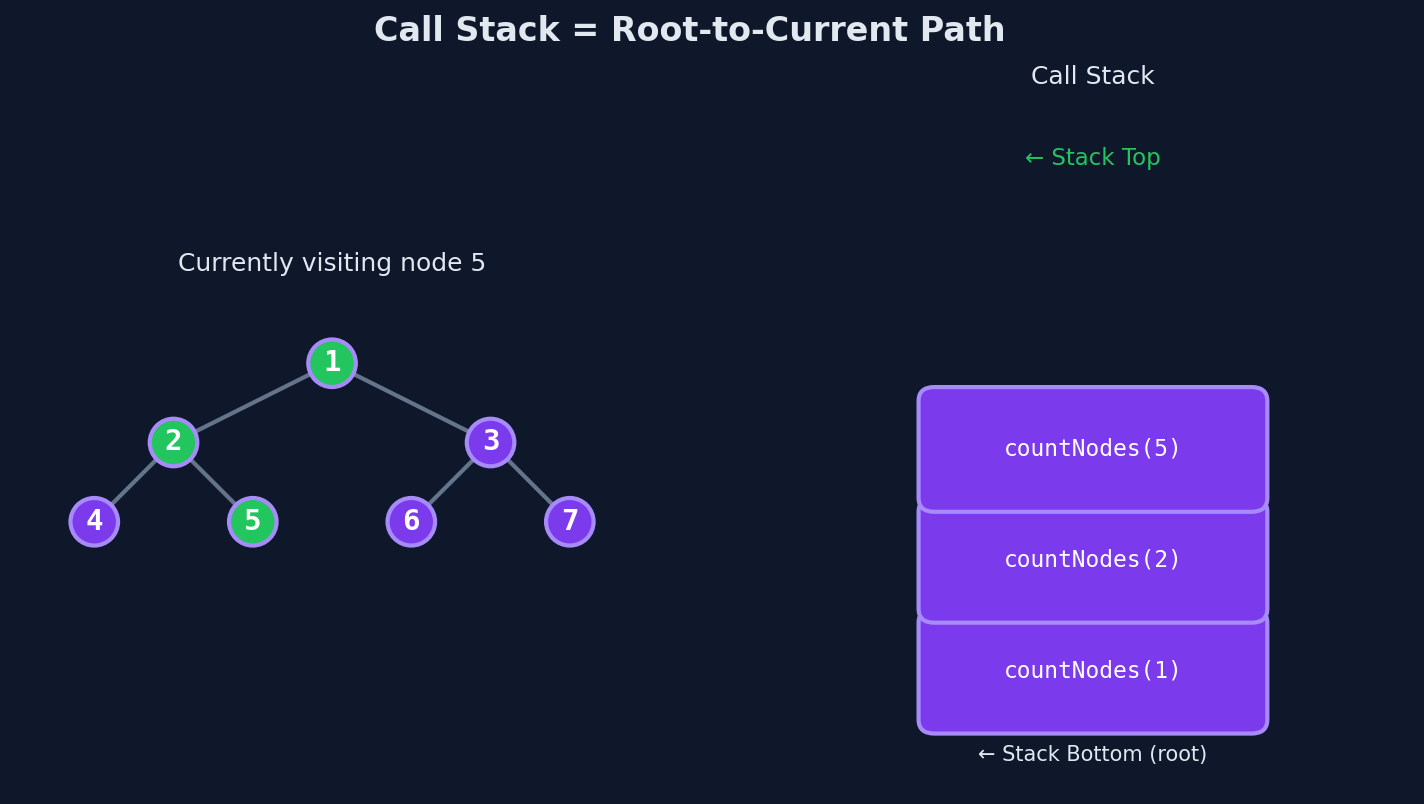
Here's the full trace. The "Call Stack" column shows the frames from bottom (root) to top (current node):
| Step | Action | Call Stack (bottom → top) | Path from Root |
|---|---|---|---|
| 1 | Enter node 1 | [1] |
\(1\) |
| 2 | Enter node 2 | [1, 2] |
\(1 \to 2\) |
| 3 | Enter node 4 | [1, 2, 4] |
\(1 \to 2 \to 4\) |
| 4 | Enter node 6 | [1, 2, 4, 6] |
\(1 \to 2 \to 4 \to 6\) |
| 5 | 6 has no children — return | [1, 2, 4] |
\(1 \to 2 \to 4\) |
| 6 | 4's right is nullptr — return | [1, 2] |
\(1 \to 2\) |
| 7 | Enter node 5 | [1, 2, 5] |
\(1 \to 2 \to 5\) |
| 8 | 5 has no children — return | [1, 2] |
\(1 \to 2\) |
| 9 | 2 is done — return | [1] |
\(1\) |
| 10 | Enter node 3 | [1, 3] |
\(1 \to 3\) |
| 11 | 3's left is nullptr — skip | [1, 3] |
\(1 \to 3\) |
| 12 | Enter node 7 | [1, 3, 7] |
\(1 \to 3 \to 7\) |
| 13 | 7 has no children — return | [1, 3] |
\(1 \to 3\) |
| 14 | 3 is done — return | [1] |
\(1\) |
| 15 | 1 is done — return | [] |
(empty) |
Read columns 3 and 4. They're identical at every step. The call stack and the root-to-current path are the same thing.
Why This Matters
This isn't a coincidence — it's structural. Think about what a function call does:
- When you enter a child, the child's frame gets pushed onto the stack.
- When you finish a child and return to the parent, the child's frame gets popped off the stack.
Pushing and popping match the DFS traversal exactly. Going deeper in the tree = pushing. Backtracking = popping. The call stack mirrors the tree path at every moment.
Recursion doesn't traverse the tree. It becomes the tree.
The call tree of a DFS function is an exact copy of the input tree. Every node in the tree corresponds to exactly one stack frame. The parent-child relationships in the tree are the caller-callee relationships in the recursion.
Stack Depth = Tree Height
Look at the trace again. The maximum call stack size was 4 frames — at step 4, when we reached node 6. The stack was [1, 2, 4, 6].
The height of the tree is 3 (the longest root-to-leaf path has 3 edges: \(1 \to 2 \to 4 \to 6\)). Add 1 for the root frame itself: maximum stack depth = height + 1.
In terms of space complexity, the recursive DFS on a tree uses \(O(h)\) space, where \(h\) is the height.
This has a real consequence. If someone gives you a tree that's actually a long chain — say, \(10^5\) nodes in a straight line — the height is \(10^5\). The call stack will hold \(10^5\) frames. On most systems, the default stack size is about \(10^6\) bytes (1 MB). Each frame takes at least a few dozen bytes. You will get a stack overflow.
Stack overflow on tree problems is not a bug in your logic. It's a depth problem. When the tree is deep, recursion costs real memory — one frame per level.
Two Stacks, Two Uses
The call stack during DFS serves two purposes that are worth distinguishing:
The Active Path Stack (Push & Pop): At any moment during DFS, the call stack contains exactly the path from root to the current node. When you enter a node, it's pushed. When you leave, it's popped. This gives you \(O(1)\) access to all ancestors of the current node — no need for parent pointers or binary lifting.
You can make this explicit by maintaining your own stack alongside the recursion:
vector<int> pathStack;

void dfs(Node* node) {
    if (!node) return;
    pathStack.push_back(node->value);
    // pathStack now holds the root-to-current path
    // print it, query ancestors, check conditions — all O(1) per ancestor
    dfs(node->left);
    dfs(node->right);
    pathStack.pop_back();  // backtrack
}
The History Stack (Push Only): If you record every node you visit in order (without popping), you get the preorder traversal — a 1D "shadow" of the tree. Add entry and exit timestamps, and you get the Euler Tour — the foundation of tree linearization in Chapter 11. The active path gives you ancestor access; the history gives you subtree ranges.
This is why balanced trees (\(h = O(\log n)\)) are safe to recurse on, but degenerate trees (\(h = O(n)\)) are dangerous. A balanced tree with \(10^6\) nodes has height ~20. A degenerate chain with \(10^6\) nodes has height \(10^6\).
The Code
Here's a simple DFS that prints each node and its current depth. The depth parameter is the call stack position — proof that the stack tracks the path.
void dfs(Node* root, int currentDepth) {
    if (!root) return;
    cout << "Node " << root->value << " at depth " << currentDepth << "\n";
    dfs(root->left, currentDepth + 1);
    dfs(root->right, currentDepth + 1);
}
Output:
Node 1 at depth 0
Node 2 at depth 1
Node 4 at depth 2
Node 6 at depth 3
Node 5 at depth 2
Node 3 at depth 1
Node 7 at depth 2
The currentDepth variable tells you how many frames are on the stack above main. Node 6 is at depth 3 — the stack holds frames for nodes 1, 2, 4, and 6. Four frames, depth 3. It lines up.
Max Depth: Your First Height Problem
Now use the stack insight to solve a real problem.
Problem: Given a binary tree, return its maximum depth. Maximum depth is the number of edges on the longest path from root to any leaf.
The recursive question: If I know the max depth of the left subtree and the max depth of the right subtree, what's the max depth of the whole tree?
It's 1 + max(leftDepth, rightDepth). One edge connects this node to the deeper child, plus however deep that child goes.
Base case: nullptr returns \(-1\). A single node (leaf) then computes 1 + max(-1, -1) = 0, which is correct — a leaf has depth 0.
int maxDepth(Node* root) {
    if (!root) return -1;
    int leftDepth = maxDepth(root->left);
    int rightDepth = maxDepth(root->right);
    return 1 + max(leftDepth, rightDepth);
}
Trace on our 7-node tree:
| Call | Node | Left returns | Right returns | Result |
|---|---|---|---|---|
| maxDepth(6) | 6 | -1 | -1 | 0 |
| maxDepth(4) | 4 | 0 (from 6) | -1 (nullptr) | 1 |
| maxDepth(5) | 5 | -1 | -1 | 0 |
| maxDepth(2) | 2 | 1 (from 4) | 0 (from 5) | 2 |
| maxDepth(7) | 7 | -1 | -1 | 0 |
| maxDepth(3) | 3 | -1 (nullptr) | 0 (from 7) | 1 |
| maxDepth(1) | 1 | 2 (from 2) | 1 (from 3) | 3 |
Maximum depth = 3. The path is \(1 \to 2 \to 4 \to 6\). This matches the maximum stack depth we observed in the trace table above — 4 frames, 3 edges.
Try It
The starter code has a maxDepth function with a TODO. Fill in the body.
Predict before running: At what point during the DFS does the call stack reach its maximum size? Which node triggers it? (Answer: node 6. The stack holds [1, 2, 4, 6] — 4 frames.)
Challenge: What does maxDepth return on a tree that's a straight line: \(1 \to 2 \to 3 \to 4 \to 5\)? How many stack frames are active at the deepest point? What happens if the chain has \(10^6\) nodes?
Practice — Predict the Call Stack: For our 7-node tree, what is the exact call stack at the moment node 5 is being processed? Write it out before checking the trace table. (Answer: [1, 2, 5].)
What about when node 7 is being processed? (Answer: [1, 3, 7].)
What about right after node 6 returns and we're back at node 4, about to check its right child? (Answer: [1, 2, 4].)
Edge Cases to Watch For
- Depth definition varies by problem: Some problems define depth as number of nodes on the longest path (returning 0 for null), others as number of edges (returning \(-1\) for null). Always check whether the problem counts nodes or edges and adjust the base case accordingly.
- Minimum depth vs maximum depth:
minDepthhas a subtle trap — if one child isnullptr, you must NOT take the min of \(-1\) and the other child's depth. A null child does not form a leaf path. Handle the one-child case explicitly with anifguard.
Problems
| Problem | Link | Difficulty |
|---|---|---|
| LC 104 — Maximum Depth of Binary Tree | leetcode.com/problems/maximum-depth-of-binary-tree | Easy |
| LC 111 — Minimum Depth of Binary Tree | leetcode.com/problems/minimum-depth-of-binary-tree | Easy |