Recursion Tree Visualization
Every Recursive Call Is a Node
You've been working with trees as data structures — nodes with children, stored in memory. But there's another kind of tree that shows up everywhere in algorithm analysis: the recursion tree.
Every time a function calls itself, that call is a node. Its recursive subcalls are its children. The entire execution of a recursive function IS a tree.
This isn't a metaphor. It's literal. And once you learn to draw it, you can see why some algorithms are fast and others are catastrophically slow.
Draw the Tree for fib(6)
The naive Fibonacci function:
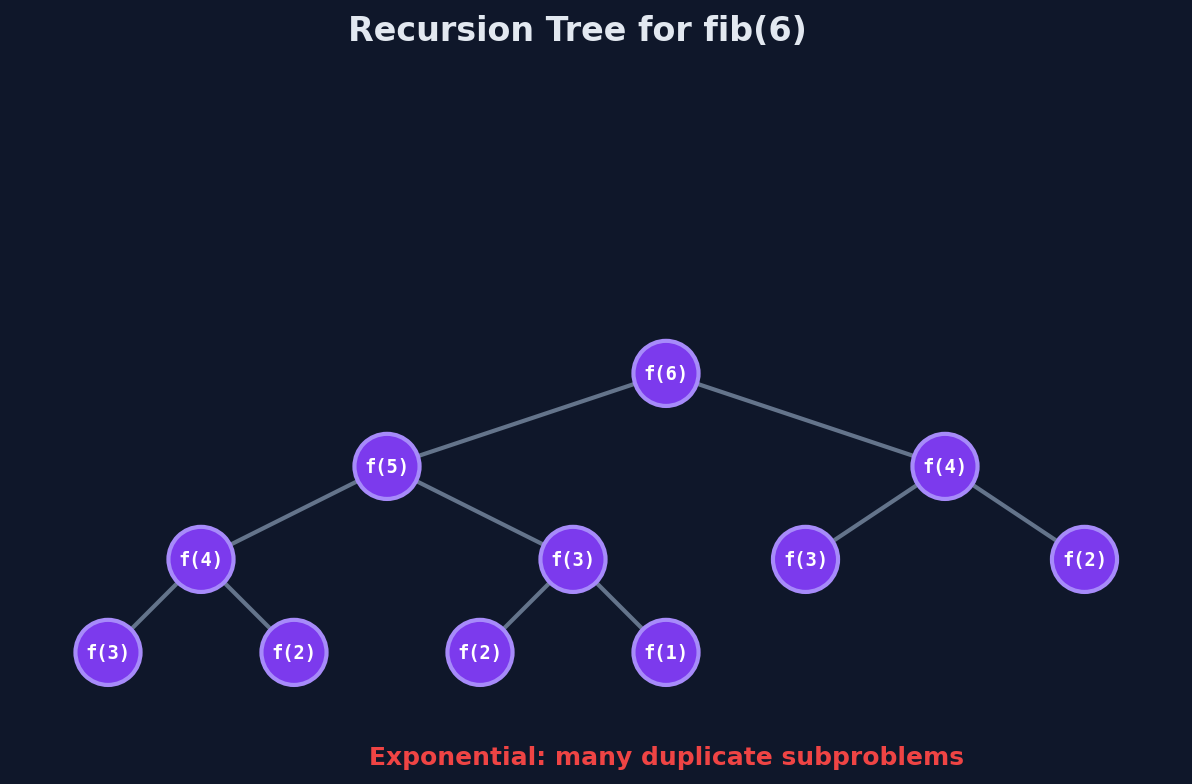
Every call to fibonacci(n) makes two subcalls: fibonacci(n-1) and fibonacci(n-2). That's a binary tree.
                          fib(6)
                        /        \
                   fib(5)          fib(4)
                  /      \        /      \
             fib(4)    fib(3)  fib(3)   fib(2)
            /    \     /   \    /   \    /   \
        fib(3) fib(2) f(2) f(1) f(2) f(1) f(1) f(0)
        /   \   / \   / \
     f(2) f(1) f(1) f(0) f(1) f(0)
     / \
   f(1) f(0)
Count the nodes: 25 function calls to compute fib(6) = 8.
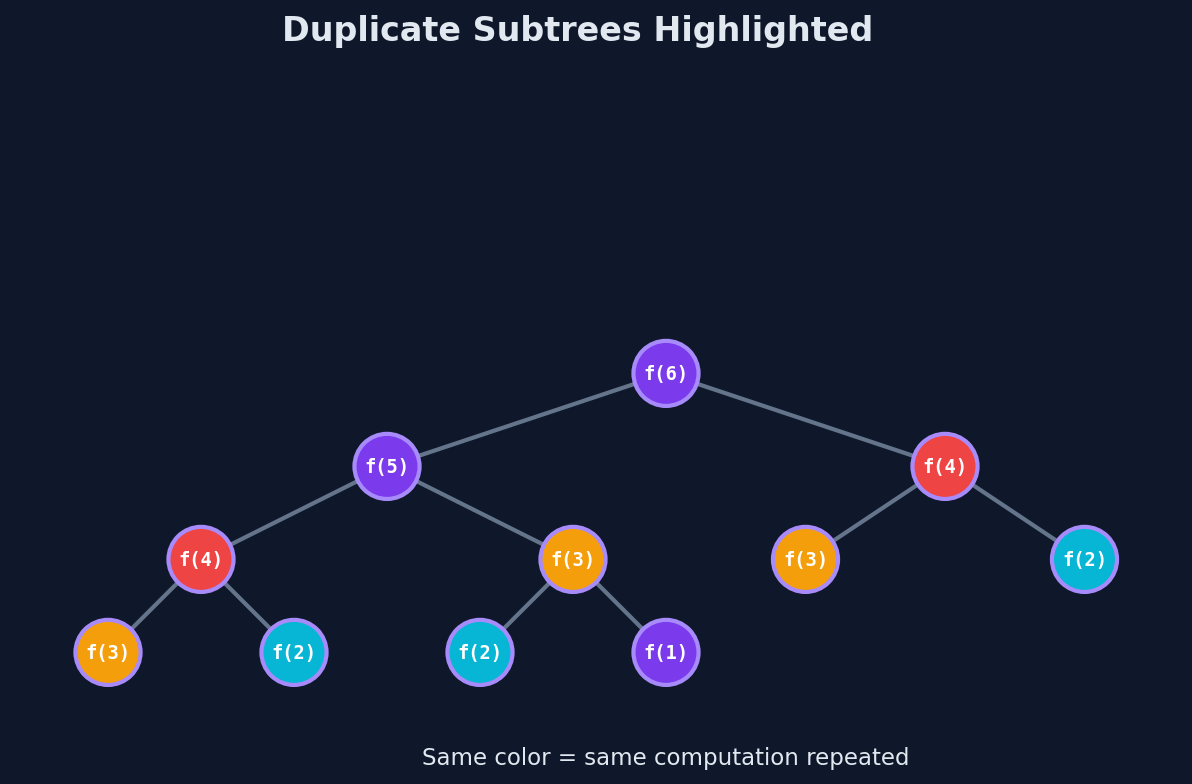
Look at the tree carefully. fib(4) appears twice. fib(3) appears three times. fib(2) appears five times. The tree is full of identical subtrees — the same computation repeated over and over.
Redundant computation = identical subtrees in the recursion tree. If you see the same subtree appearing multiple times, the algorithm is doing unnecessary work.
The Numbers Tell the Story
| \(n\) | fib(\(n\)) | Number of calls |
|---|---|---|
| 1 | 1 | 1 |
| 2 | 1 | 3 |
| 3 | 2 | 5 |
| 4 | 3 | 9 |
| 5 | 5 | 15 |
| 6 | 8 | 25 |
| 10 | 55 | 177 |
| 20 | 6765 | 21,891 |
| 40 | 102334155 | ~331 million |
The number of calls grows exponentially — roughly \(O(2^n)\). More precisely, it's \(O(\phi^n)\) where \(\phi \approx 1.618\) is the golden ratio. For \(n = 40\), you're making over 300 million calls to compute a number that fits in a 32-bit integer.
Memoization: Collapsing the Tree
What if, the first time you compute fib(4), you store the result? The second time someone asks for fib(4), you return the stored value immediately — no subtree, no recursion.
int fibonacciMemo(int n, vector<int>& memo) {
    if (n <= 1) return n;
    if (memo[n] != -1) return memo[n];
    memo[n] = fibonacciMemo(n - 1, memo) + fibonacciMemo(n - 2, memo);
    return memo[n];
}
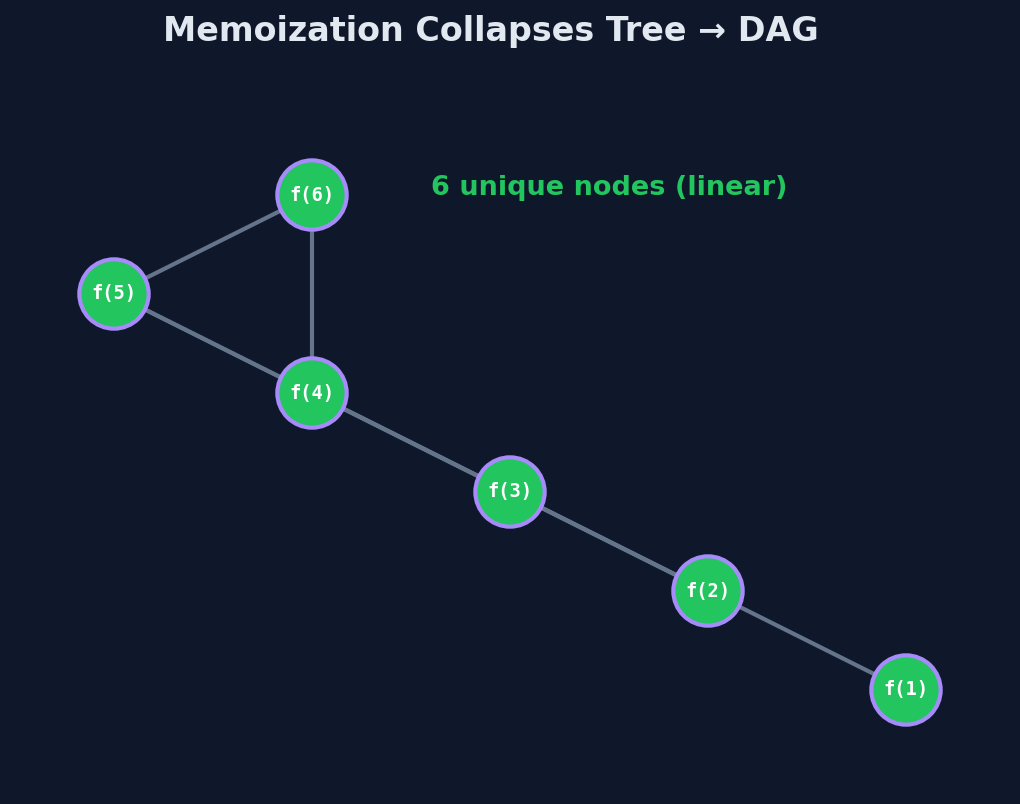
The recursion tree with memoization:
    fib(6)
    /    \
  fib(5)  fib(4) ← cached, returns immediately
  /    \
fib(4)  fib(3) ← cached
/    \
fib(3) fib(2) ← cached
/    \
fib(2) fib(1) ← base case
/    \
fib(1) fib(0) ← base cases
The right child of almost every node is a cache hit — a single lookup, not a subtree. The tree has collapsed into essentially a chain: fib(6) → fib(5) → fib(4) → fib(3) → fib(2) → fib(1).
Only 7 unique subproblems are solved: fib(0) through fib(6). Everything else is a cache lookup. From 25 calls down to 11 (7 real computations + 4 cache hits).
| Step | Call | Computed or Cached? | Result |
|---|---|---|---|
| 1 | fib(6) | Compute | — |
| 2 | fib(5) | Compute | — |
| 3 | fib(4) | Compute | — |
| 4 | fib(3) | Compute | — |
| 5 | fib(2) | Compute | — |
| 6 | fib(1) | Base case | 1 |
| 7 | fib(0) | Base case | 0 |
| 8 | fib(2) returns | — | 1 |
| 9 | fib(1) | Cached | 1 |
| 10 | fib(3) returns | — | 2 |
| 11 | fib(2) | Cached | 1 |
| 12 | fib(4) returns | — | 3 |
| 13 | fib(3) | Cached | 2 |
| 14 | fib(5) returns | — | 5 |
| 15 | fib(4) | Cached | 3 |
| 16 | fib(6) returns | — | 8 |
The Visual Insight
Here's what to take away from this:
The DP table is the collapsed tree laid flat. Each cell in the table corresponds to a unique node in the recursion tree. Memoization eliminates the duplicate subtrees. Bottom-up DP eliminates the tree entirely and fills the table in order.
The fib DP table: [0, 1, 1, 2, 3, 5, 8]. Seven entries — one per unique subproblem. The recursion tree had 25 nodes, but only 7 were unique. The table keeps only the unique ones.
This is why drawing the recursion tree is the first step when analyzing any recursive algorithm. The tree shows you:
- How many total calls — the tree size gives the time complexity of the naive version.
- How many unique calls — the number of distinct subproblems gives the time complexity after memoization.
- Which calls are redundant — identical subtrees are the targets for memoization.
We show you the visualization here. The DP course will teach you how to systematically identify subproblems, define recurrences, and fill tables bottom-up. The tree is the lens — the optimization technique comes later.
Try It
The starter code has both fibonacci and fibonacciMemo. Run both for \(n = 6\) and verify they return the same value.
Predict before running: How many times does the naive fibonacci call fibonacci(2)? Draw the tree and count. (Answer: 5 times.)
Challenge: Add a global counter to fibonacci and fibonacciMemo to count total function calls. Compare the counts for \(n = 20\). The naive version should make about 21,891 calls. The memoized version should make about 37.
Challenge 2: Can you draw the recursion tree for fibonacci(7) by extending the fib(6) tree? How many nodes does it have? (Hint: fib(7) calls fib(6) and fib(5). You already know the subtree for fib(6) has 25 nodes and fib(5) has 15.)
Edge Cases to Watch For
- Memo array too small: If the memo vector has size \(n\) but indices go up to \(n\), you get an out-of-bounds access. Initialize with size \(n + 1\).
- Negative \(n\): The base case
n <= 1catches \(n = 0\) and \(n = 1\), but negative \(n\) would cause infinite recursion. Add a guardif (n < 0) return 0or document the precondition. - Integer overflow:
fib(46)exceedsINT_MAX(\(2^{31} - 1\)). For large \(n\), uselong long.fib(93)exceedsLLONG_MAX.
Problems
| Problem | Link | Difficulty |
|---|---|---|
| LC 509 — Fibonacci Number | leetcode.com/problems/fibonacci-number | Easy |
| LC 70 — Climbing Stairs | leetcode.com/problems/climbing-stairs | Easy |