Step-by-Step Directions via LCA
Paths Between Two Nodes
Every tree path problem eventually reduces to the same core idea: find the LCA, then stitch together the two half-paths. This problem makes that completely explicit by asking you to output the actual directions.
Problem: Step-By-Step Directions (LC 2096)
Problem: You are given the root of a binary tree with \(n\) nodes, each with a unique value. You are also given a \(startValue\) and a \(destValue\). Find the shortest path from the node with \(startValue\) to the node with \(destValue\) and return it as a string of directions:
'U'— move to parent'L'— move to left child'R'— move to right child
\(startValue = 3\), \(destValue = 6\). Answer: "UURL".
The path: \(3 \xrightarrow{U} 1 \xrightarrow{U} 5 \xrightarrow{R} 2 \xrightarrow{L} 6\).
The Key Observation
Any path between two nodes in a tree goes up from the source to their Lowest Common Ancestor (LCA), then down from the LCA to the destination. There are no shortcuts — trees have exactly one path between any two nodes.
So the problem breaks into three pieces:
- Find the path from root to source (a string of L's and R's).
- Find the path from root to destination (a string of L's and R's).
- Strip the common prefix (the shared path from root to LCA), convert the remaining source path to all U's, and append the remaining destination path.
The approach: Find both root-to-node paths, strip their common prefix (that's the LCA), then the answer is U's for the source remainder + L/R's for the destination remainder.
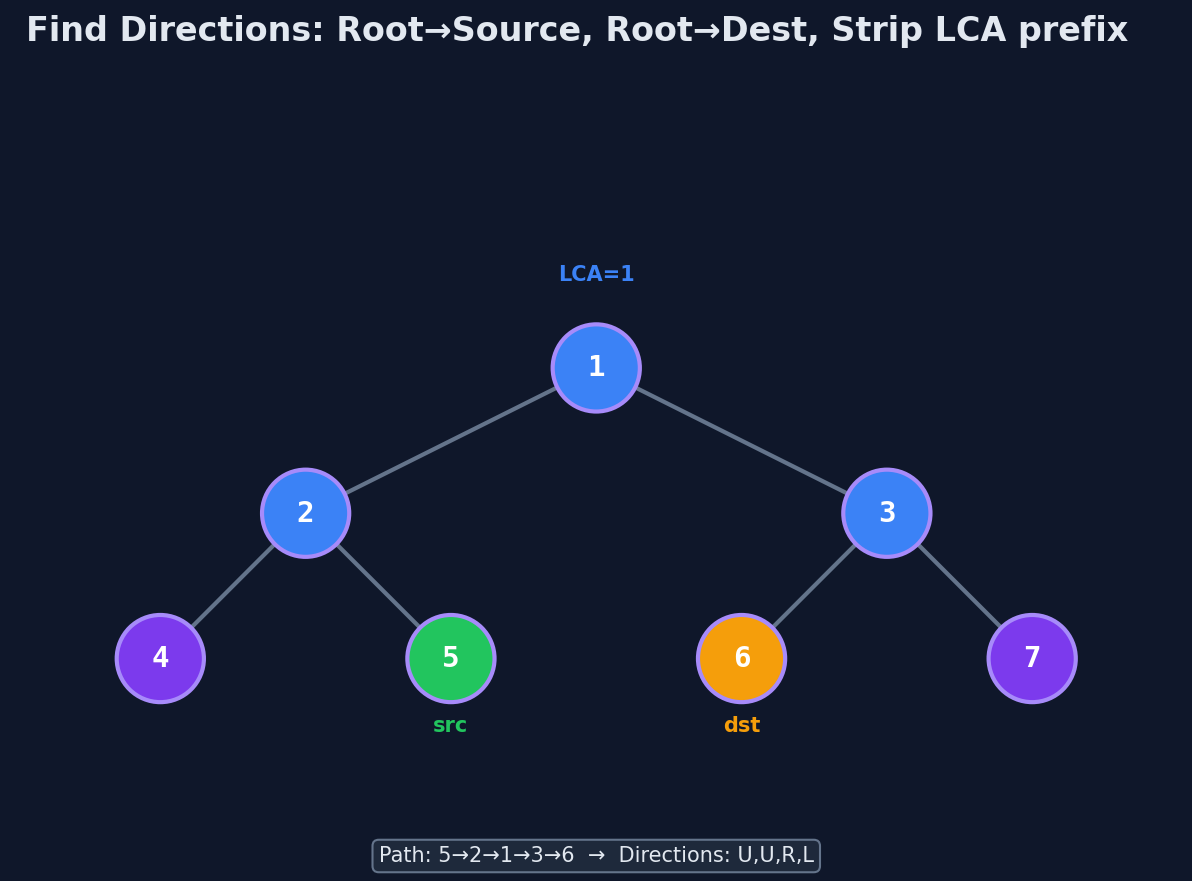
Why This Works
Consider the paths from root to each node:
- Root to source (node 3): L, L (\(5 \to 1 \to 3\))
- Root to dest (node 6): R, L (\(5 \to 2 \to 6\))
Common prefix: empty (they diverge immediately — 'L' vs 'R'). The LCA is the root (node 5).
- Source remainder: "LL" — that's 2 steps up, so "UU".
- Dest remainder: "RL" — that's the downward path.
- Result: "UU" + "RL" = "UURL".
Now consider \(startValue = 3\), \(destValue = 1\) on the same tree:
- Root to source (node 3): L, L
- Root to dest (node 1): L
Common prefix: "L" (the path to node 1). The LCA is node 1.
- Source remainder after stripping "L": "L" — that's 1 step up, so "U".
- Dest remainder after stripping "L": "" — already at destination.
- Result: "U".
Full Trace
\(startValue = 3\), \(destValue = 6\).
Step 1: Find path from root to node 3.
| Node visited | Direction taken | Path so far |
|---|---|---|
| 5 | L (go to child 1) | "L" |
| 1 | L (go to child 3) | "LL" |
| 3 | found target | "LL" |
$pathToSource = $ "LL"
Step 2: Find path from root to node 6.
| Node visited | Direction taken | Path so far |
|---|---|---|
| 5 | R (go to child 2) | "R" |
| 2 | L (go to child 6) | "RL" |
| 6 | found target | "RL" |
$pathToDest = $ "RL"
Step 3: Strip common prefix and build result.
| Index | pathToSource[i] | pathToDest[i] | Match? |
|---|---|---|---|
| 0 | L | R | No — stop |
Common prefix length: 0. LCA is the root (node 5).
- Source remainder: "LL" (length 2) \(\to\) "UU"
- Dest remainder: "RL"
- Final answer: "UU" + "RL" = "UURL"
Manual verification: \(3 \xrightarrow{U} 1 \xrightarrow{U} 5 \xrightarrow{R} 2 \xrightarrow{L} 6\). Correct.
The Code
bool findPath(TreeNode* node, int target, string& path) {
    if (!node) return false;
    if (node->val == target) return true;

    path.push_back('L');
    if (findPath(node->left, target, path)) return true;
    path.pop_back();

    path.push_back('R');
    if (findPath(node->right, target, path)) return true;
    path.pop_back();

    return false;
}

string getDirections(TreeNode* root, int startValue, int destValue) {
    string pathToSource, pathToDest;
    findPath(root, startValue, pathToSource);
    findPath(root, destValue, pathToDest);

    int commonLength = 0;
    while (commonLength < (int)pathToSource.size()
           && commonLength < (int)pathToDest.size()
           && pathToSource[commonLength] == pathToDest[commonLength]) {
        commonLength++;
    }

    string result(pathToSource.size() - commonLength, 'U');
    result += pathToDest.substr(commonLength);
    return result;
}
Complexity: \(O(n)\) time (two DFS passes + one linear scan of paths), \(O(n)\) space.
Why Not Find LCA Explicitly?
You could find the LCA first, then build paths from LCA to source and LCA to dest. But finding root-to-node paths and stripping the common prefix implicitly finds the LCA without a separate function. The common prefix IS the path from root to LCA.
Both approaches are \(O(n)\). The path-stripping version is cleaner to implement and avoids writing a separate LCA function. On an OA, fewer moving parts means fewer bugs.
Try It
Predict before running: What if source and dest are the same node? Both paths are identical, common prefix covers everything, source remainder is empty, dest remainder is empty. Result: "". That's correct — you're already there.
Challenge: What if the tree is a straight line (every node has only a left child) with \(10^5\) nodes, and source is the deepest node while dest is the root? The path string will be \(10^5\) U's. Does the solution still run in \(O(n)\)?
Problems
| Problem | Link | Difficulty |
|---|---|---|
| LC 2096 --- Step-By-Step Directions | leetcode.com/problems/step-by-step-directions-from-a-binary-tree-node-to-another | Medium |
| LC 236 --- Lowest Common Ancestor | leetcode.com/problems/lowest-common-ancestor-of-a-binary-tree | Medium |
| LC 257 --- Binary Tree Paths | leetcode.com/problems/binary-tree-paths | Easy |
| LC 129 — Sum Root to Leaf Numbers | leetcode.com/problems/sum-root-to-leaf-numbers | Medium |
| LC 1443 — Min Time to Collect Apples | leetcode.com/problems/minimum-time-to-collect-all-apples-in-a-tree | Medium |
| LC 1376 — Time to Inform All Employees | leetcode.com/problems/time-needed-to-inform-all-employees | Medium |
What's Next?
You can now traverse trees in every direction and solve view/path/distance problems. But what about building trees from scratch? Chapter 5 teaches construction — from traversal pairs, serialization, and flattening.