Two-Pointer Graph
A palindrome reads the same forwards and backwards. On a string, you check with two pointers walking inward. On a graph, both pointers traverse edges simultaneously — and their edge labels must match.
The Problem
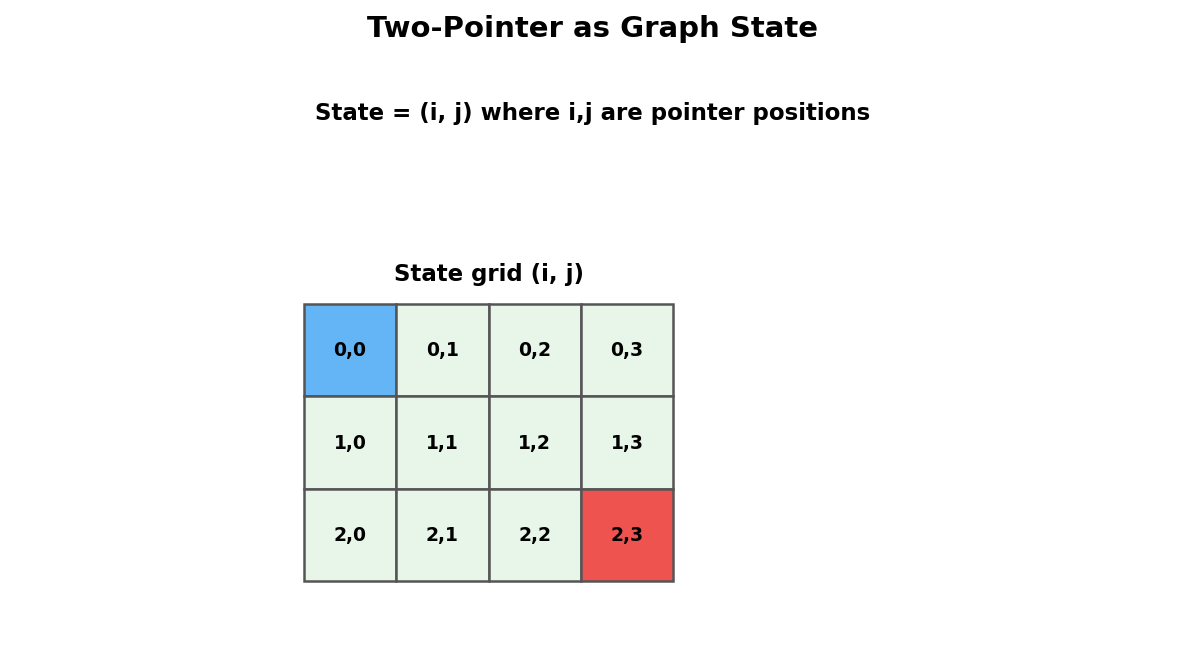
ABC197-F Construct a Palindrome: Undirected graph with character-labeled edges. Find the shortest path from vertex 1 to vertex N whose edge labels form a palindrome. Output -1 if impossible.
The palindrome constraint couples the beginning and end of the path. You can't just run BFS from one side.
The Two-Pointer Insight
Place one pointer at vertex 1, another at vertex N. Both walk inward. At each step, both traverse an edge, and the edge labels must match.
💡 Key insight. State = (u, v) where u is where pointer A is, v is where pointer B is. BFS on pairs finds the shortest matching walk.
When Do the Pointers Meet?
- Even-length palindrome: u == v (both pointers at same node). Path length = 2 × BFS distance.
- Odd-length palindrome: u and v are neighbors (connected by any edge). Path length = 2 × BFS distance + 1.
Trace
Consider a graph: 1—(a)—2—(b)—3—(b)—4—(a)—5.
| Step | (u, v) | Dist | Action |
|---|---|---|---|
| Init | (1, 5) | 0 | Start: pointer A at 1, pointer B at 5 |
| Pop | (1, 5) | 0 | Edge (1,2,'a') and (5,4,'a') match → push (2,4) |
| Pop | (2, 4) | 1 | Edge (2,3,'b') and (4,3,'b') match → push (3,3) |
| Pop | (3, 3) | 2 | u == v → even palindrome, length = 4 |
Path: 1→2→3→4→5, labels: a-b-b-a. Palindrome!
The Code
int main() {
    int n, m;
    cin >> n >> m;
    vector<vector<pair<int,char>>> adj(n + 1);
    for (int i = 0; i < m; i++) {
        int u, v; char c;
        cin >> u >> v >> c;
        adj[u].push_back({v, c});
        adj[v].push_back({u, c});
    }

    auto enc = [&](int u, int v) -> long long {
        return (long long)u * (n + 1) + v;
    };

    queue<pair<int,int>> q;
    unordered_map<long long, int> dist;
    q.push({1, n});
    dist[enc(1, n)] = 0;

    while (!q.empty()) {
        auto [u, v] = q.front(); q.pop();
        int d = dist[enc(u, v)];

        if (u == v) { cout << 2 * d << "\n"; return 0; }

        // Check odd-length: u and v are neighbors
        for (auto [nv, _] : adj[u])
            if (nv == v) { cout << 2 * d + 1 << "\n"; return 0; }

        // Expand: match edge labels from both sides
        for (auto [nu, cu] : adj[u])
            for (auto [nv, cv] : adj[v])
                if (cu == cv && !dist.count(enc(nu, nv))) {
                    dist[enc(nu, nv)] = d + 1;
                    q.push({nu, nv});
                }
    }
    cout << -1 << "\n";
}
Complexity
States: O(N²). Per state: O(deg(u) × deg(v)). Total: O(N² × D²). Feasible for N ≤ 2000 with bounded degree.
⚠ Gotcha. Both pointers use the same undirected adjacency list. Pointer B doesn't walk "backwards" — it walks forward from vertex N into the graph.
The General Pattern
Two-pointer graph BFS works when: 1. You match constraints from both ends of a path. 2. The constraint is symmetric (palindrome, matching pairs). 3. Path length is the optimization target.
This is "meet in the middle" for constraint satisfaction, not for speed.
Exercises
- If the graph is directed, pointer B must use reversed edges. Why?
- Can this find the longest palindrome path? What changes?
- What if you need the actual path, not just its length?
Problems
| Problem | Link | Difficulty |
|---|---|---|
| ABC197-F Construct a Palindrome | atcoder.jp | Hard |