Top-Down vs Bottom-Up
Two Kinds of Questions
Every tree problem asks you to move information through the tree. And information can only flow in two directions: down from parent to child, or up from child to parent.
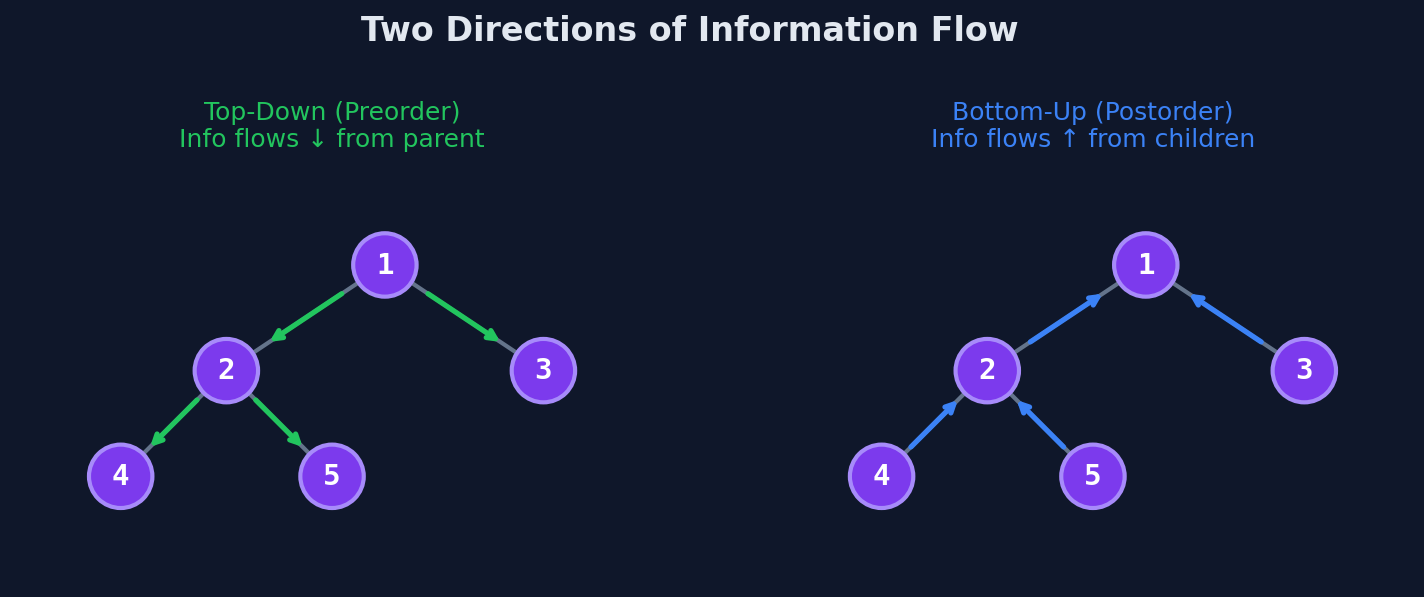
That's it. There is no third option. Once you learn to identify which direction a problem needs, the recursive structure writes itself.
Top-Down: Passing Information Downward
Top-down means the parent tells the child something. The child uses that information, updates it, and passes it to its own children. The flow is root → leaves.
This is preorder processing. You do work at the current node before recursing into children, because the children need the result of that work.
Example question: "Does any root-to-leaf path in this tree sum to 22?"
Think about what a node needs to answer this. Node 11 can't answer on its own — it doesn't know what the nodes above it summed to. The parent has to pass that running sum down.
Here's our tree:
The path \(5 \to 4 \to 11 \to 2\) sums to \(5 + 4 + 11 + 2 = 22\). That's a match.
The algorithm: at each node, pass the remaining sum to the children. Start with targetSum = 22. At node 5, subtract 5 — pass 17 down. At node 4, subtract 4 — pass 13 down. At node 11, subtract 11 — pass 2 down. At node 2, subtract 2 — remaining is 0. We've hit a leaf with remaining sum 0. Found it.
| Node | Remaining Sum Received | After Subtracting | Leaf? | Match? |
|---|---|---|---|---|
| 5 | 22 | 17 | No | — |
| 4 | 17 | 13 | No | — |
| 11 | 13 | 2 | No | — |
| 7 | 2 | -5 | Yes | No |
| 2 | 2 | 0 | Yes | Yes |
| 8 | 17 | 9 | Yes | No |
The information flows downward. Each node receives something from its parent, processes it, and hands the updated version to its children.
bool hasPathSum(Node* root, int remainingSum) {
    if (!root) return false;
    remainingSum -= root->value;
    if (!root->left && !root->right) return remainingSum == 0;
    return hasPathSum(root->left, remainingSum) || hasPathSum(root->right, remainingSum);
}
Notice the structure: the work happens before the recursive calls. We update remainingSum, then pass it down. That's the top-down signature.
Bottom-Up: Collecting Information Upward
Bottom-up means the children report results to the parent. The parent combines those results with its own value to produce its answer. The flow is leaves → root.
This is postorder processing. You recurse into children first, then do work at the current node, because the current node needs the children's answers.
Example question: "What is the height of this tree?"
A node can't know its height without knowing the height of its subtrees. It has to wait for its children to report back.
Same tree:
| Call | Node | Left returns | Right returns | Result |
|---|---|---|---|---|
| height(7) | 7 | -1 | -1 | 0 |
| height(2) | 2 | -1 | -1 | 0 |
| height(11) | 11 | 0 (from 7) | 0 (from 2) | 1 |
| height(4) | 4 | 1 (from 11) | -1 (nullptr) | 2 |
| height(8) | 8 | -1 | -1 | 0 |
| height(5) | 5 | 2 (from 4) | 0 (from 8) | 3 |
The information flows upward. Each node waits for its children, then combines.
int height(Node* root) {
    if (!root) return -1;
    int leftHeight = height(root->left);
    int rightHeight = height(root->right);
    return 1 + max(leftHeight, rightHeight);
}
Notice the structure: the recursive calls happen before the work. We get leftHeight and rightHeight first, then compute the answer. That's the bottom-up signature.
The Same Problem, Both Ways
To really see the difference, solve the same problem using both approaches.
Problem: Does a tree contain a node with value \(target\)?
Top-down approach: Pass the target down. At each node, check if the current value matches. If yes, return true. Otherwise, keep passing the target to children.
bool containsTopDown(Node* root, int target) {
    if (!root) return false;
    if (root->value == target) return true;
    return containsTopDown(root->left, target) || containsTopDown(root->right, target);
}
Bottom-up approach: Ask each subtree "do you contain the target?" Collect the boolean results upward.
bool containsBottomUp(Node* root, int target) {
    if (!root) return false;
    bool foundInLeft = containsBottomUp(root->left, target);
    bool foundInRight = containsBottomUp(root->right, target);
    return root->value == target || foundInLeft || foundInRight;
}
Both work. Both visit every node in the worst case. But notice the difference in when each node does its work:
- Top-down checks the current node first, then recurses. If it finds the target early (near the root), it can short-circuit.
- Bottom-up recurses first, then checks the current node. It always visits the entire subtree before deciding.
For this particular problem, top-down is more natural. But for problems like height, diameter, or subtree sums — where you need information from below — bottom-up is the only option.
If you need information from above (parent, ancestors, running totals), it's top-down. If you need information from below (subtree sizes, heights, existence checks), it's bottom-up.
The Classification Skill
Recognizing which direction you need is THE skill for tree problems. It determines the shape of your recursion before you write a single line of code.
Here are six problems. For each one, decide: top-down, bottom-up, or both?
1. "Return the maximum value in the tree."
You need to know the max of the left subtree and the max of the right subtree to compute the max of the whole tree. Information flows up. Bottom-up.
2. "Print all root-to-leaf paths."
You need to know the path from the root to the current node, which means you need information from above. Pass the current path down as a parameter. Top-down.
3. "Return the diameter of the tree (longest path between any two nodes)."
The diameter through a node is leftHeight + rightHeight + 2. You need heights from below (bottom-up). But you also need to track the global maximum as you go — which you can do with a reference variable passed downward or maintained across calls. Primarily bottom-up.
4. "Check if the tree is symmetric."
You compare left and right subtrees by mirroring. The comparison results bubble up from children to parents. Bottom-up.
5. "Given a path sum target, return all root-to-leaf paths that sum to it."
You need the running sum from above (top-down to pass the remaining sum). You also need to know when you've hit a leaf (bottom-up isn't needed — you check at the leaf). Top-down.
6. "Find the lowest common ancestor of two nodes."
You need to know whether the target nodes exist in the left or right subtree. That information comes from below. Bottom-up.
The Combined Pattern
Some problems need both directions. Here's the template:
int solve(Node* root, int infoFromAbove, int& globalAnswer) {
    if (!root) return baseValue;

    int leftResult = solve(root->left, updatedInfo, globalAnswer);
    int rightResult = solve(root->right, updatedInfo, globalAnswer);

    int localAnswer = combine(leftResult, rightResult, root->value);
    globalAnswer = max(globalAnswer, localAnswer);

    return localAnswer;
}
The infoFromAbove parameter carries top-down information. The return value carries bottom-up information. The globalAnswer reference collects the overall result. You'll see this exact pattern in diameter, max path sum, and a dozen other problems later in the course.
The Code: Path Sum (Top-Down)
The full solution for LC 112 — the top-down example from above:
bool hasPathSum(Node* root, int remainingSum) {
    if (!root) return false;
    remainingSum -= root->value;
    if (!root->left && !root->right) return remainingSum == 0;
    return hasPathSum(root->left, remainingSum) || hasPathSum(root->right, remainingSum);
}
Complexity: \(O(n)\) time, \(O(h)\) space — where \(h\) is the height of the tree (the call stack depth).
Try It
The starter code has hasPathSum with a TODO. Fill in the body.
Predict before running: What does hasPathSum return for the path \(5 \to 8\)? Node 8 is a leaf. Remaining sum after subtracting: \(22 - 5 - 8 = 9\). Not zero. So this path fails.
Challenge — Bottom-Up Variant: Write a function allPathSums(Node* root) that returns a vector of all root-to-leaf path sums. Is this top-down or bottom-up? (Hint: you need the running sum from above, so you pass it down as a parameter. It's top-down, even though you collect results into a vector.)
Challenge 2: Write binaryTreePaths(Node* root) that returns all root-to-leaf paths as strings like "5->4->11->2". What direction does the information flow? What do you pass as a parameter?
Edge Cases to Watch For
- Target sum of zero with non-leaf nodes: A non-leaf node with value 0 should NOT trigger a match. The path must end at a leaf. Always check
!root->left && !root->rightbefore declaring a match. - Negative node values: The remaining sum can go negative and then positive again. Do not prune early based on the remaining sum being negative — it might recover.
- Collecting all matching paths (LC 113): The
||short-circuit inhasPathSumstops after finding the first match. When collecting ALL matching paths, you must explore both subtrees unconditionally — use separate recursive calls instead of||.
Problems
| Problem | Link | Difficulty |
|---|---|---|
| LC 112 — Path Sum | leetcode.com/problems/path-sum | Easy |
| LC 257 — Binary Tree Paths | leetcode.com/problems/binary-tree-paths | Easy |