Java Advantages
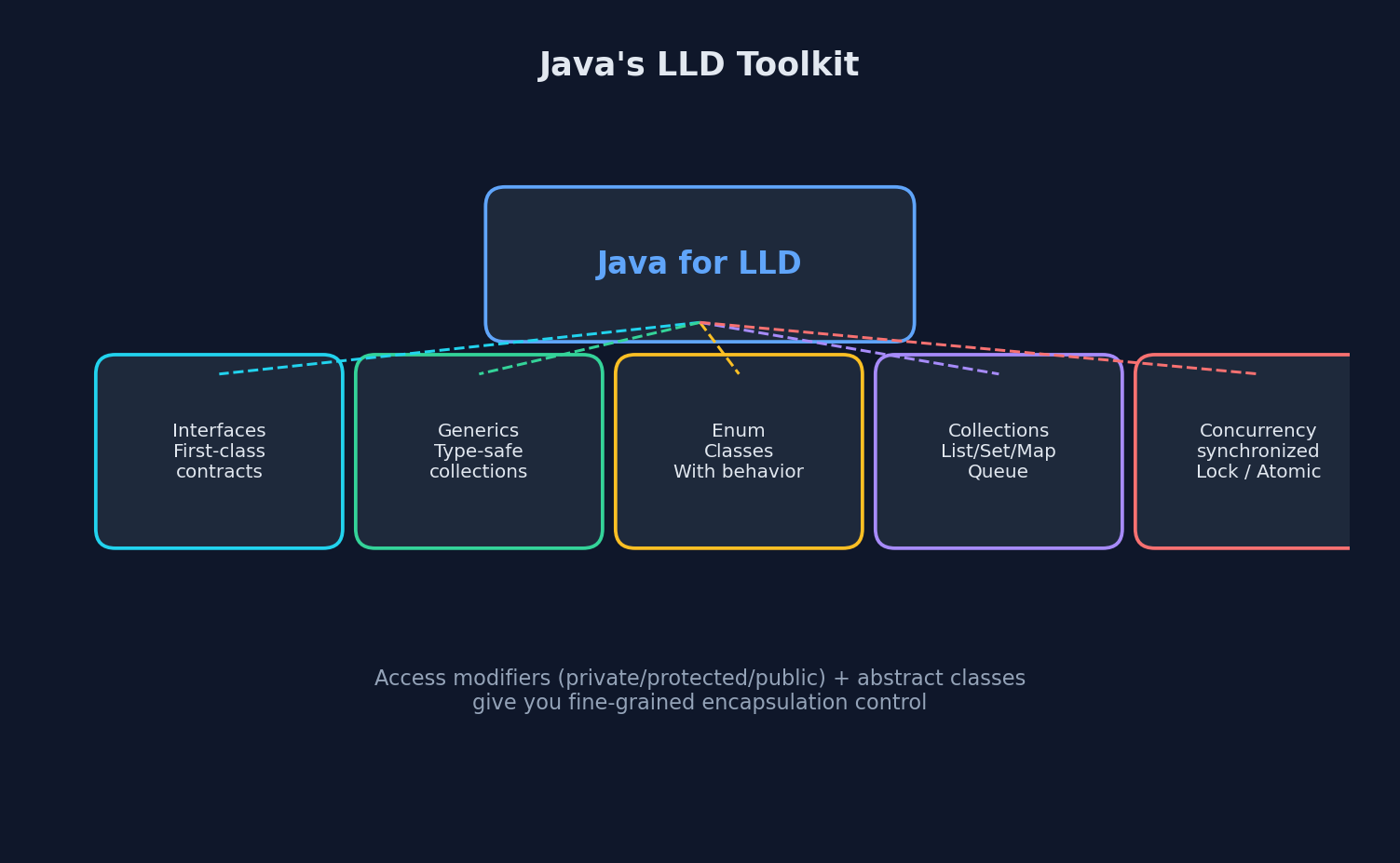
TL;DR: Java dominates LLD interviews because its OOP primitives -- interfaces, abstract classes, enums with behavior, and fine-grained access modifiers -- map directly to the design patterns you'll be asked to implement. You can use any language, but understanding why Java fits so naturally will make you better in whichever language you choose.
Why Java Became the Default
Walk into any LLD interview, open any online course, or read any LLD blog post. The examples are almost always in Java. This isn't an accident. Java's language features were designed around OOP from day one, and LLD interviews are fundamentally about OOP.
Three things make Java the path of least resistance for LLD:
-
Interfaces are first-class citizens. You declare an
interface, any class canimplementit, and the compiler enforces the contract. No workarounds, no conventions, no metaclasses. -
The type system catches design mistakes at compile time. If you forget to implement a method from an interface, the code doesn't compile. If you pass the wrong type, the code doesn't compile. In an interview, this means fewer "oops" moments.
-
The standard library mirrors LLD patterns. Java's collections framework (
List,Set,Map,Queue) is itself a textbook example of interface-based design. You're using the patterns while you learn them.
Interfaces as First-Class Citizens
In LLD, you constantly define contracts: "a payment processor must be able to charge and refund." In Java, this is a single keyword:
interface PaymentProcessor {
    boolean charge(Money amount, PaymentMethod method);
    boolean refund(String transactionId);
}

class StripeProcessor implements PaymentProcessor {
    @Override
    public boolean charge(Money amount, PaymentMethod method) {
        // Stripe-specific logic
        return true;
    }

    @Override
    public boolean refund(String transactionId) {
        // Stripe-specific logic
        return true;
    }
}
A class can implement multiple interfaces. This is how Java handles the "diamond problem" without the complexity of multiple inheritance:
class StripeProcessor implements PaymentProcessor, Auditable, Retryable {
    // Must implement all methods from all three interfaces
}
The compiler enforces every method. You cannot "forget" to implement refund(). This matters in interviews because incomplete implementations are a common reason candidates fail.
Abstract Classes: Shared Code with Enforced Contracts
When multiple classes share behavior but also have unique parts, abstract classes give you both:
abstract class Vehicle {
    private String licensePlate;
    private VehicleType type;

    public Vehicle(String licensePlate, VehicleType type) {
        this.licensePlate = licensePlate;
        this.type = type;
    }

    // Shared behavior -- all vehicles have this
    public String getLicensePlate() {
        return licensePlate;
    }

    public VehicleType getType() {
        return type;
    }

    // Subclasses MUST implement this
    abstract int getRequiredSpots();
}

class Motorcycle extends Vehicle {
    public Motorcycle(String plate) {
        super(plate, VehicleType.MOTORCYCLE);
    }

    @Override
    int getRequiredSpots() { return 1; }
}

class Bus extends Vehicle {
    public Bus(String plate) {
        super(plate, VehicleType.BUS);
    }

    @Override
    int getRequiredSpots() { return 5; }
}
The abstract class provides getLicensePlate() and getType() for free, while forcing each subclass to define getRequiredSpots(). This is the "template" half of the Template Method pattern, which you'll see constantly in LLD.
The Collections Framework: LLD in Practice
Java's collections aren't just useful -- they're an example of the interface-based design you're being tested on.
| Interface | Common Implementations | When to Use in LLD |
|---|---|---|
List<E> |
ArrayList, LinkedList |
Ordered items: order history, playlist songs |
Set<E> |
HashSet, TreeSet |
Unique items: active users, assigned spots |
Map<K,V> |
HashMap, TreeMap, LinkedHashMap |
Lookups: userId to User, spotId to Vehicle |
Queue<E> |
LinkedList, PriorityQueue |
Waiting lists, task queues, request buffering |
HashMap vs TreeMap
This comes up in interviews more than you'd expect:
// HashMap: O(1) lookup, no ordering
Map<String, User> usersById = new HashMap<>();

// TreeMap: O(log n) lookup, keys are sorted
// Use when you need range queries or ordered iteration
Map<LocalDateTime, Booking> bookingsByTime = new TreeMap<>();
When the interviewer asks "how would you find all bookings between 2pm and 5pm?" -- if you used a TreeMap, you can answer with subMap(). If you used a HashMap, you're stuck iterating everything. The data structure choice is part of the design.
ArrayList vs LinkedList
For LLD interviews, default to ArrayList. It has better cache locality, O(1) random access, and covers 95% of use cases. LinkedList only wins when you need frequent insertion/removal at both ends (like implementing a deque for an LRU cache).
HashMap vs TreeMap vs LinkedHashMap
| Feature | HashMap | TreeMap | LinkedHashMap |
|---|---|---|---|
| Lookup time | O(1) average | O(log n) | O(1) average |
| Ordering | None | Sorted by key | Insertion order |
| Null keys | One allowed | Not allowed | One allowed |
| LLD use case | Most lookups by ID | Range queries, sorted display | LRU cache, ordered history |
When each one matters in an interview:
// HashMap -- default choice for ID-based lookups
// "Find the ticket for license plate XYZ"
Map<String, Ticket> ticketsByPlate = new HashMap<>();

// TreeMap -- when you need range queries
// "Find all bookings between 2pm and 5pm"
TreeMap<LocalDateTime, Booking> bookingsByTime = new TreeMap<>();
List<Booking> afternoon = new ArrayList<>(
    bookingsByTime.subMap(
        LocalDateTime.of(2024, 1, 1, 14, 0),
        LocalDateTime.of(2024, 1, 1, 17, 0)
    ).values()
);

// LinkedHashMap -- when insertion order matters
// "Show the last 10 search queries in order"
Map<String, Integer> searchHistory = new LinkedHashMap<>();

// LinkedHashMap with access-order -- LRU cache
Map<String, CacheEntry> lruCache = new LinkedHashMap<>(16, 0.75f, true) {
    @Override
    protected boolean removeEldestEntry(Map.Entry<String, CacheEntry> eldest) {
        return size() > MAX_CACHE_SIZE;
    }
};
// C++ equivalents
std::unordered_map<std::string, Ticket> ticketsByPlate;  // HashMap
std::map<std::chrono::time_point<...>, Booking> bookingsByTime;  // TreeMap
// No direct LinkedHashMap equivalent -- use a list + unordered_map combo
# Python equivalents
tickets_by_plate: dict[str, Ticket] = {}  # dict preserves insertion order (3.7+)
from sortedcontainers import SortedDict
bookings_by_time = SortedDict()  # TreeMap equivalent
from collections import OrderedDict  # explicit insertion-ordered dict
Set Choices Matter Too
// HashSet -- "is this spot occupied?" O(1) check
Set<Integer> occupiedSpotIds = new HashSet<>();

// TreeSet -- "give me all available spot IDs in sorted order"
TreeSet<Integer> availableSpots = new TreeSet<>();
int lowestAvailable = availableSpots.first();  // O(log n)

// LinkedHashSet -- "show seats in the order they were reserved"
Set<String> reservedSeats = new LinkedHashSet<>();
Queue Variants in LLD
// LinkedList as Queue -- FIFO waiting list
Queue<RideRequest> waitingRequests = new LinkedList<>();

// PriorityQueue -- process highest-priority items first
// "VIP customers get matched with drivers before regular customers"
Queue<RideRequest> prioritizedRequests = new PriorityQueue<>(
    Comparator.comparing(RideRequest::getPriority).reversed()
        .thenComparing(RideRequest::getRequestTime)  // FIFO within same priority
);

// ArrayDeque -- when you need both ends (faster than LinkedList)
Deque<Move> moveHistory = new ArrayDeque<>();  // undo stack for chess
Enums with Behavior
Java enums aren't just named constants. They can have fields, methods, and constructors. This is a feature most candidates underuse in interviews.
enum VehicleType {
    MOTORCYCLE(1),
    CAR(2),
    BUS(5);

    private final int requiredSpots;

    VehicleType(int requiredSpots) {
        this.requiredSpots = requiredSpots;
    }

    public int getRequiredSpots() {
        return requiredSpots;
    }
}

// Usage: no switch statement needed
int spots = vehicle.getType().getRequiredSpots();
Compare this to a plain enum where you'd need a switch statement every time you want the spot count. The behavior lives with the data, which is exactly the OOP principle encapsulation teaches.
This pattern eliminates scattered switch statements and keeps related logic in one place. When you add a new VehicleType, you're forced to provide requiredSpots -- the compiler won't let you forget.
Real-World Example: Order Status with Allowed Transitions
In a real e-commerce system, you don't want code scattered across the codebase deciding which status transitions are legal. The enum itself can enforce it:
enum OrderStatus {
    PENDING(Set.of("CONFIRMED", "CANCELLED")),
    CONFIRMED(Set.of("SHIPPED", "CANCELLED")),
    SHIPPED(Set.of("DELIVERED", "RETURNED")),
    DELIVERED(Set.of("RETURNED")),
    CANCELLED(Set.of()),
    RETURNED(Set.of());

    private final Set<String> allowedTransitions;

    OrderStatus(Set<String> allowedTransitions) {
        this.allowedTransitions = allowedTransitions;
    }

    public boolean canTransitionTo(OrderStatus next) {
        return allowedTransitions.contains(next.name());
    }
}

// Usage -- no switch statement, no scattered if-else
public void updateStatus(OrderStatus newStatus) {
    if (!currentStatus.canTransitionTo(newStatus)) {
        throw new IllegalStateException(
            "Cannot transition from " + currentStatus + " to " + newStatus);
    }
    this.currentStatus = newStatus;
}
// C++ doesn't have enum methods, so you use a function + map
enum class OrderStatus { PENDING, CONFIRMED, SHIPPED, DELIVERED, CANCELLED, RETURNED };

bool canTransition(OrderStatus from, OrderStatus to) {
    static const std::unordered_map<OrderStatus, std::unordered_set<OrderStatus>> allowed = {
        {OrderStatus::PENDING, {OrderStatus::CONFIRMED, OrderStatus::CANCELLED}},
        {OrderStatus::CONFIRMED, {OrderStatus::SHIPPED, OrderStatus::CANCELLED}},
        {OrderStatus::SHIPPED, {OrderStatus::DELIVERED, OrderStatus::RETURNED}},
        {OrderStatus::DELIVERED, {OrderStatus::RETURNED}},
        {OrderStatus::CANCELLED, {}},
        {OrderStatus::RETURNED, {}}
    };
    auto it = allowed.find(from);
    return it != allowed.end() && it->second.count(to);
}
# Python -- use a dictionary on the enum
from enum import Enum

class OrderStatus(Enum):
    PENDING = {"CONFIRMED", "CANCELLED"}
    CONFIRMED = {"SHIPPED", "CANCELLED"}
    SHIPPED = {"DELIVERED", "RETURNED"}
    DELIVERED = {"RETURNED"}
    CANCELLED = set()
    RETURNED = set()

    def can_transition_to(self, next_status: 'OrderStatus') -> bool:
        return next_status.name in self.value
In Java, adding a new OrderStatus forces you to declare its valid transitions in the constructor. You cannot forget. In Python, you could add a new status and forget to add it to transition checks elsewhere. In C++, you'd need to remember to update the map. Java catches the error at compile time.
Real-World Example: Spot Size with Dimensions
enum SpotSize {
    SMALL(8, 12, "Motorcycles, scooters"),
    MEDIUM(10, 18, "Sedans, SUVs"),
    LARGE(12, 24, "Trucks, buses, RVs");

    private final int widthFeet;
    private final int lengthFeet;
    private final String description;

    SpotSize(int widthFeet, int lengthFeet, String description) {
        this.widthFeet = widthFeet;
        this.lengthFeet = lengthFeet;
        this.description = description;
    }

    public int getWidthFeet() { return widthFeet; }
    public int getLengthFeet() { return lengthFeet; }
    public int getAreaSqFt() { return widthFeet * lengthFeet; }
    public String getDescription() { return description; }

    public boolean canFit(VehicleType vehicle) {
        return this.ordinal() >= vehicle.getMinimumSpotSize().ordinal();
    }
}
Every operation that depends on spot dimensions lives on the enum. No utility class, no constants file, no scattered switch statements.
Access Modifiers: Four Levels of Control
Java gives you four access levels, more than most languages:
| Modifier | Class | Package | Subclass | World |
|---|---|---|---|---|
private |
Yes | No | No | No |
| (package-private, default) | Yes | Yes | No | No |
protected |
Yes | Yes | Yes | No |
public |
Yes | Yes | Yes | Yes |
In LLD interviews, the key decisions are:
- Fields are
private. Always. No exceptions in an interview context. - Methods the outside world calls are
public. These form your class's API. - Methods that subclasses need but the outside world shouldn't see are
protected. Common in template method patterns. - Package-private is rarely discussed in interviews, but it's useful for classes that collaborate closely within a package.
Interview tip: Use the language you're most comfortable with, but be aware that Java's OOP constructs map most naturally to LLD concepts. If you use Python or C++, you'll need to know the equivalent patterns -- which is exactly what the next lesson covers.
What Each Level Protects Against
Here is why each level exists, with concrete bugs they prevent.
private -- Protects internal invariants
class ParkingLot {
    private int occupiedCount;  // Only modified by enter() and exit()
    private final int capacity;

    // Without private, someone could write:
    //   lot.occupiedCount = -5;  // breaks getAvailableSpots()
    //   lot.occupiedCount = lot.capacity + 100;  // impossible state

    public int getAvailableSpots() {
        return capacity - occupiedCount;  // Always correct because occupiedCount is private
    }
}
protected -- Shared with subclasses, hidden from everyone else
abstract class FeeCalculator {
    // Subclasses need this to implement their own fee logic
    protected double getBaseRate() {
        return 2.50;  // dollars per hour
    }

    // But external code should never call getBaseRate() directly --
    // they call calculate(), which may apply discounts, caps, etc.
    public abstract double calculate(Instant entry, Instant exit);
}

class WeekendFeeCalculator extends FeeCalculator {
    @Override
    public double calculate(Instant entry, Instant exit) {
        double hours = Duration.between(entry, exit).toHours();
        return hours * getBaseRate() * 1.5;  // 50% weekend surcharge
    }
}
package-private (default) -- Collaborating classes within a module
// Both classes are in the same package: com.parking.core

class SpotAssigner {  // package-private class
    int findBestSpot(SpotSize size, Set<Integer> occupied) {  // package-private method
        // Only ParkingLot (same package) can call this
        // External code cannot instantiate SpotAssigner directly
    }
}

public class ParkingLot {
    private final SpotAssigner assigner = new SpotAssigner();

    public Ticket enter(VehicleType type, String plate) {
        int spot = assigner.findBestSpot(mapToSize(type), occupiedSpotIds);
        // ...
    }
}
Comparison: How Java, C++, and Python Handle Access
| Feature | Java | C++ | Python |
|---|---|---|---|
| Private enforcement | Compiler-enforced private |
Compiler-enforced private: |
Convention only (_prefix) |
| Protected | Subclass + same package | Subclass + friend classes | Convention only (_prefix) |
| Package-level | Default (no modifier) | No equivalent | No equivalent |
| Public | public keyword |
public: section |
Everything by default |
| Can bypass? | Only with reflection | Only with pointer tricks | Always (no enforcement) |
This is one reason Java catches more bugs in LLD code. If you accidentally access a private field in Java, the compiler rejects it immediately. In Python, obj._balance = -500 works silently. In an interview, this means Java code is more likely to be correct the first time you write it.
Java's Type System Catches LLD Bugs at Compile Time
Here is a real category of bug that Java catches but Python does not.
The wrong-type-in-collection bug:
# Python -- no type error until runtime (or never, until a customer hits it)
class ParkingLot:
    def __init__(self):
        self._tickets = {}

    def enter(self, vehicle_type, license_plate):
        ticket = Ticket(license_plate, datetime.now())
        self._tickets[license_plate] = ticket
        return ticket

    def exit(self, license_plate):
        ticket = self._tickets.pop(license_plate)
        # Oops: someone earlier did self._tickets["ABC123"] = "not a ticket"
        # This crashes here, far from where the bug was introduced
        return ticket.entry_time  # AttributeError at runtime
// Java -- caught at compile time
class ParkingLot {
    private Map<String, Ticket> activeTickets = new HashMap<>();

    public Ticket enter(VehicleType type, String plate) {
        Ticket ticket = new Ticket(plate, Instant.now());
        activeTickets.put(plate, ticket);
        return ticket;
    }

    // This line won't compile:
    // activeTickets.put("ABC123", "not a ticket");  // COMPILE ERROR
}
The forgotten-interface-method bug:
# Python -- no error until the method is actually called
class PaymentProcessor:
    def charge(self, amount): ...
    def refund(self, transaction_id): ...

class StripeProcessor(PaymentProcessor):
    def charge(self, amount):
        return True
    # Forgot to implement refund()!
    # No error until someone calls stripe.refund() in production
// Java -- compile error immediately
interface PaymentProcessor {
    boolean charge(Money amount);
    boolean refund(String transactionId);
}

class StripeProcessor implements PaymentProcessor {
    @Override
    public boolean charge(Money amount) { return true; }
    // COMPILE ERROR: StripeProcessor must implement refund(String)
}
These aren't hypothetical. In a 45-minute interview, you write code fast and don't have time for thorough testing. Java's compiler acts as a safety net that catches entire categories of mistakes before you even run the code.
Interview tip: If an interviewer asks "why use Java for LLD?" the strongest answer is: "Java's type system catches design violations at compile time -- missing interface methods, wrong types in collections, illegal access to private fields. In a time-pressured interview, that means fewer bugs and more time for design."
Quick Recap
| Java Feature | Why It Matters for LLD |
|---|---|
| Interfaces | Define contracts the compiler enforces; enable Strategy, Observer, and other patterns |
| Abstract classes | Share code across related classes while enforcing subclass-specific behavior |
| Collections framework | Map, Set, List, Queue -- the building blocks of every LLD data model |
| Enums with behavior | Eliminate switch statements; keep data and logic together |
| Access modifiers | Four levels of visibility give precise control over encapsulation |
| Strong type system | Catches design mistakes at compile time, not at runtime |